

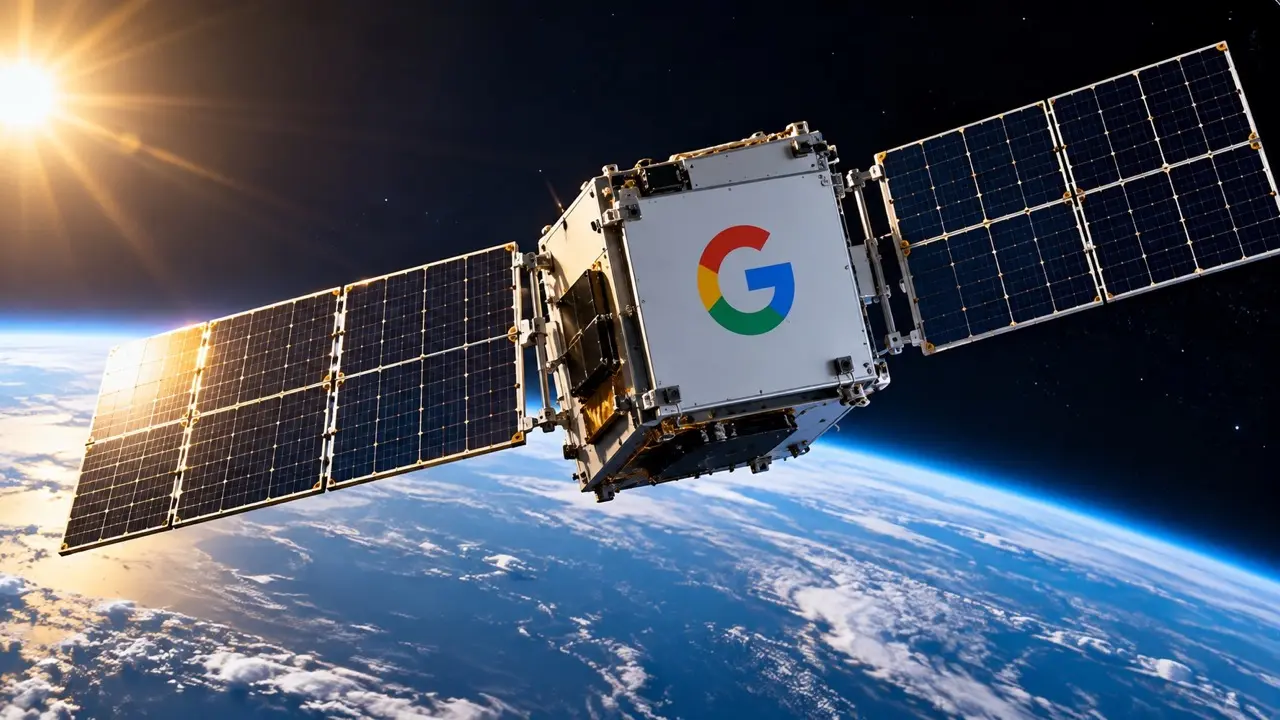
Google will send four of its TPU artificial-intelligence accelerators into orbit on October 1, taking the first physical step toward Project Suncatcher, its long-term attempt to determine whether large AI computing systems could eventually operate in space.
The experiment will fly aboard SpaceX’s Transporter-18 rideshare mission from California. The launch is currently targeted for October 1, although spaceflight schedules can still change. Calling the spacecraft an orbital data center would be premature. The prototype, nicknamed MVP and built using a Planet satellite platform, is roughly refrigerator-sized. It carries four Google TPUs and solar panels producing only about one kilowatt of power. A terrestrial AI data center can contain thousands of accelerators consuming vastly more electricity. The mission is instead designed to answer a more basic question. Can ordinary AI hardware survive and operate reliably in space?
Google will study how its Trillium TPUs withstand launch vibration, radiation and extreme thermal conditions. Ground tests suggest the chips can tolerate more radiation than they would accumulate during a five-year orbital mission, but real spaceflight remains the decisive test.
Cooling may be the hardest problem. On Earth, data centers can move heat using air or liquid cooling. In the vacuum of space there is no surrounding air, so heat ultimately has to be radiated away. Google’s prototype uses heat pipes and radiators, but the system can currently run its AI workload for only about 15 minutes before the TPUs must cool down.
The attraction of orbit is energy. Google estimates satellites in low Earth orbit could access near-continuous sunlight and potentially generate up to eight times more solar energy than comparable systems on Earth. A future Suncatcher architecture would connect many satellites carrying dozens of TPUs each through extremely fast laser links, effectively turning the constellation into one distributed computing system.
That vision remains years away. Google and Planet still plan to launch two more purpose-built prototypes in 2027 to test high-bandwidth communication between satellites. The October mission is primarily an engineering experiment to find out whether the foundations of an orbital AI data center are technically workable at all.