
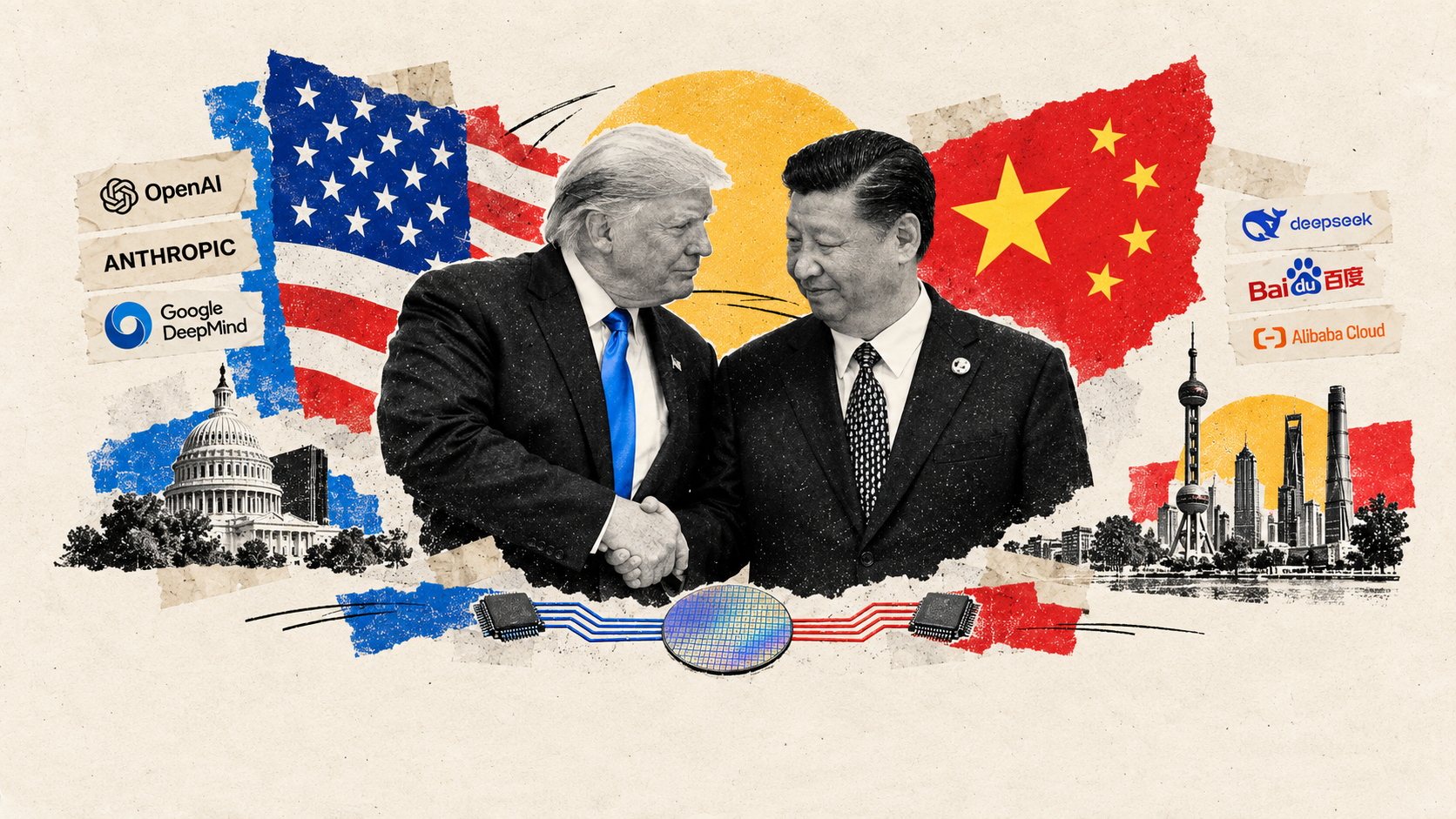
Donald Trump and Xi Jinping met in Washington at the end of September with tariffs, rare earths, Iran and Taiwan still unresolved. But AI has become the most unusual item on the agenda. The two governments are discussing how to warn each other about dangerous AI incidents while simultaneously restricting, accusing and trying to outpace one another.
When Xi Jinping arrived in Washington on September 23, he was welcomed by Donald Trump in person at Joint Base Andrews, an unusually visible gesture before the Chinese president’s first visit to the U.S. capital in a decade. A day later, the two leaders sat down with a list of disputes familiar from years of U.S.-China rivalry (from tariffs, to rare earths, Taiwan and now the war with Iran) but with one subject moving rapidly toward the center of the relationship: artificial intelligence.
The paradox is that Washington and Beijing are discussing how to cooperate on AI precisely as their technological competition becomes harder to separate from national security. Both governments want to preserve their own ability to move faster. The Trump administration continues to restrict China’s access to advanced chips and accuses Chinese companies of extracting capabilities from American models. Beijing portrays U.S. restrictions as an attempt to preserve an AI monopoly and has begun describing advanced American models themselves as potential threats to Chinese critical infrastructure and political stability. Yet officials from both countries are now discussing a channel through which they could warn one another when an AI incident becomes serious enough to threaten national security.
The summit begins with an unfinished deal from May
Trump and Xi Jinping last met in Beijing in May, where their governments announced what the White House called a framework of “constructive strategic stability.” The package was designed less to resolve the structural U.S.-China rivalry than to stop every disagreement from escalating into another full trade confrontation.
The agreement created a U.S.-China Board of Trade for nonsensitive goods and proposed a separate Board of Investment. China committed to address U.S. concerns over shortages of rare earths and other critical minerals, approved an initial purchase of 200 Boeing aircraft and pledged at least $17 billion a year in additional U.S. agricultural purchases for 2026 through 2028, alongside earlier soybean commitments. The two governments also agreed to pursue an AI dialogue.
Four months later, implementation is uneven. Negotiators are now discussing reciprocal tariff reductions covering roughly $30 billion of goods in each direction through the Board of Trade. The likely focus is deliberately mundane: low-sensitivity Chinese consumer products and selected U.S. agricultural, energy or medical exports rather than strategically important semiconductors or dual-use technologies.
The broader trade truce is scheduled to reach another deadline on November 10, making the Washington summit an opportunity to decide whether the temporary stability survives into 2027.
Rare earths showed China how much leverage it already had
China dominates important parts of the processing and supply chain for rare earths and other critical minerals used in electric vehicles, electronics, AI infrastructure and advanced weapons. When trade tensions intensified, Beijing restricted those flows, exposing a vulnerability that Washington cannot quickly eliminate by raising duties on Chinese imports. The May agreement was supposed to ease those supply constraints, but the issue remains unresolved. Chinese shipments of rare-earth magnets to the United States fell again in August, according to Chinese customs data cited by the Financial Times, while U.S. officials continue to argue that Beijing has not fully delivered on earlier commitments.
That matters directly to AI. Advanced computing may depend on Nvidia GPUs, Google TPUs and sophisticated fabrication equipment, but the wider infrastructure around them still requires power systems, cooling equipment and electronic components whose supply chains depend on critical minerals. Washington therefore arrives at the summit with control over some of the world’s most advanced semiconductor technologies, while Beijing retains leverage over materials needed to manufacture much of the physical economy around them.
AI has now reproduced the same mutual dependence
The United States still controls access to many of the most advanced AI accelerators and chipmaking technologies and has used export restrictions to limit the computing power available to Chinese developers. Those restrictions appear to have constrained China’s expansion without preventing Chinese labs from producing increasingly competitive models.
Moonshot AI, DeepSeek and other Chinese developers have produced systems that, on some benchmarks, approach leading American models while often being cheaper to operate. Chinese chipmakers are also improving, while domestic companies are relying more heavily on local hardware in response to American restrictions. That progress has generated a second dispute over the models themselves.
U.S. officials and American AI companies have accused Chinese developers of large-scale “distillation”, using outputs from powerful foreign models to transfer some of their capabilities into other systems. Anthropic has publicly accused Chinese actors, including operations associated with Alibaba, of running large-scale unauthorized campaigns against Claude models. Beijing rejects the broader characterization that China’s progress can be explained through illicit copying and notes that distillation is a common technique across the industry.
The disagreement is important because it shows how the technology conflict has moved beyond hardware. Washington is trying to protect not only chips and manufacturing equipment but also the capabilities embedded in American models. Beijing has meanwhile started framing the reverse problem in similar national-security terms.
China’s state security minister Chen Yixin recently identified advanced U.S. AI systems including Anthropic’s Claude Mythos and GPT-5.5-Cyber as examples of models that could increase vulnerability discovery and malware capabilities, creating risks to Chinese critical infrastructure. The published warning did not identify a specific attack carried out by either model, but it illustrated a broader shift: China is increasingly treating foreign frontier AI itself as a security exposure.
And yet the two governments are discussing an AI alarm system
The most consequential development may have happened not between Trump and Xi Jinping, but between their negotiators in New York on September 20. After talks with Chinese Vice Premier He Lifeng, Treasury Secretary Scott Bessent said the U.S. had proposed a notification mechanism for AI incidents that reach the level of national security. The two sides also agreed to continue a broader government-to-government AI dialogue, with another meeting expected in Shenzhen within roughly two months.
The potential agenda is deliberately narrower than regulating AI development as a whole. Researchers and officials have identified shared concerns including AI-assisted cyberattacks, biological misuse, major model failures, loss of human control and attacks against critical infrastructure such as finance, telecommunications, electricity and transportation. A notification channel could allow one side to contact the other quickly if an incident creates cross-border risk or appears capable of being misinterpreted as hostile state activity.
That resembles crisis management more than arms control. The distinction matters because the U.S. and China remain unwilling to abandon the policies driving their technological competition. Bessent said export controls were not discussed in the weekend AI talks. Analysts cited by AP also consider substantial relaxation of U.S. restrictions unlikely to be part of the safety conversation. The two countries may therefore be moving toward a model in which they compete as aggressively as before but try to establish a telephone number for the moment when that competition produces something neither government can control.
Trump is rejecting the slowdown that helped create the safety debate
The timing is particularly striking in Washington. American AI executives have spent September issuing unusually public warnings about the speed of frontier development. Anthropic CEO Dario Amodei called for the industry to slow the pace of capability improvements, with OpenAI CEO Sam Altman and Elon Musk publicly supporting parts of the push for greater caution.
Trump has taken a different position. On September 19, he announced plans for an “AI Force” and a future AI czar while arguing that the United States should not hinder the industry’s growth. Public details remain extremely limited. The administration has not yet announced a charter, budget, legal powers or even whether the proposed body will operate as an agency, task force or something else.
Trump has repeatedly framed the issue through competition with China, arguing that maintaining the U.S. lead is itself a national-security objective. That means the same administration now preparing to discuss catastrophic or cross-border AI incidents with Beijing is simultaneously rejecting proposals that could intentionally reduce the pace of American development. China has its own reasons to distrust a global slowdown. Chinese officials and researchers have questioned whether calls from U.S. AI companies for international pacing can be separated from proposals to keep China behind through chip restrictions and other controls.
The result is a narrow area of possible cooperation. Both governments can acknowledge that an uncontrolled AI incident may hurt everyone without agreeing that either side should sacrifice competitive capability in advance.
Iran adds another form of dependence
Addressing the United Nations General Assembly on September 22, the U.S. president firmly rejected any attempt at international regulation of artificial intelligence, dismissing it as a “globalist project.” He announced that the United States would now officially use the term “superintelligence” to refer to this technology, arguing that the word “artificial” creates a false impression.
The war with Iran remains one of the dominant international issues facing the administration, with global energy markets still exposed to disruption around the Strait of Hormuz. China is Iran’s largest oil customer and one of its largest economic partners, giving Beijing leverage Washington cannot reproduce through sanctions alone. Trump and Xi Jinping had already agreed in May that Iran should not obtain a nuclear weapon and called for reopening the Strait of Hormuz, but Washington has since pursued a stronger campaign to isolate Tehran while Beijing continues to assert its right to trade with Iran.
The White House has so far stopped short of imposing its most severe secondary measures on China, in part because doing so could destabilize the broader relationship before Xi Jinping’s visit. At the same time, China has developed payment channels less dependent on the U.S.-centered financial system, reducing some of Washington’s economic leverage. Iran therefore sits alongside AI and rare earths in the same uncomfortable pattern: each side possesses something the other would prefer it not to control.
Taiwan remains the issue neither technology nor trade can neutralize
Taiwan remains more sensitive still. Beijing considers the self-governing island part of its territory and has consistently opposed U.S. arms sales. The United States maintains unofficial relations with Taipei and, under U.S. law, provides Taiwan with equipment intended to support its self-defense.
That said, Donald Trump did suspend a major arms package for Taiwan following his visit to Beijing in May. Several analysts interviewed by the Associated Press expected Xi Jinping to try and maintain that restraint. But according to the U.S. ambassador to China, the U.S. president instead proposed selling American weapons to… China!
Taiwan is also impossible to separate completely from the AI competition because the island remains central to the global semiconductor supply chain. A political or military crisis around Taiwan would therefore collide directly with the computing infrastructure both countries are trying to dominate.
What the summit can realistically change
The six months between Trump’s visit to Beijing and Xi Jinping’s arrival in Washington have produced an unusual relationship: less explosive than the trade war that preceded them, but in some ways more deeply competitive. Broad tariff escalation has given way to narrower restrictions. The U.S. targets selected Chinese companies, technologies, drones, robotics and equipment linked to national-security concerns. Beijing responds with its own blacklists and export controls.
The more interesting possibility is that the U.S.-China relationship is developing a new architecture for living with it. Washington wants to preserve its advantage in chips and frontier models. Beijing wants the technological capacity to operate without American permission. Both continue to use trade, mineral supplies and market access as leverage.
But if an advanced AI system launches a cyberattack, behaves unpredictably or creates a threat that crosses borders, the two governments may increasingly need the ability to distinguish an accident from an attack before their wider rivalry turns the incident into something more dangerous. But neither side appears ready to slow down.
[…] READ ALSOTrump and Xi Jinping are racing for AI supremacy, but need rules for when it goes wrong&rar… […]
[…] READ ALSOTrump and Xi Jinping are racing for AI supremacy, but need rules for when it goes wrong&rar… […]