
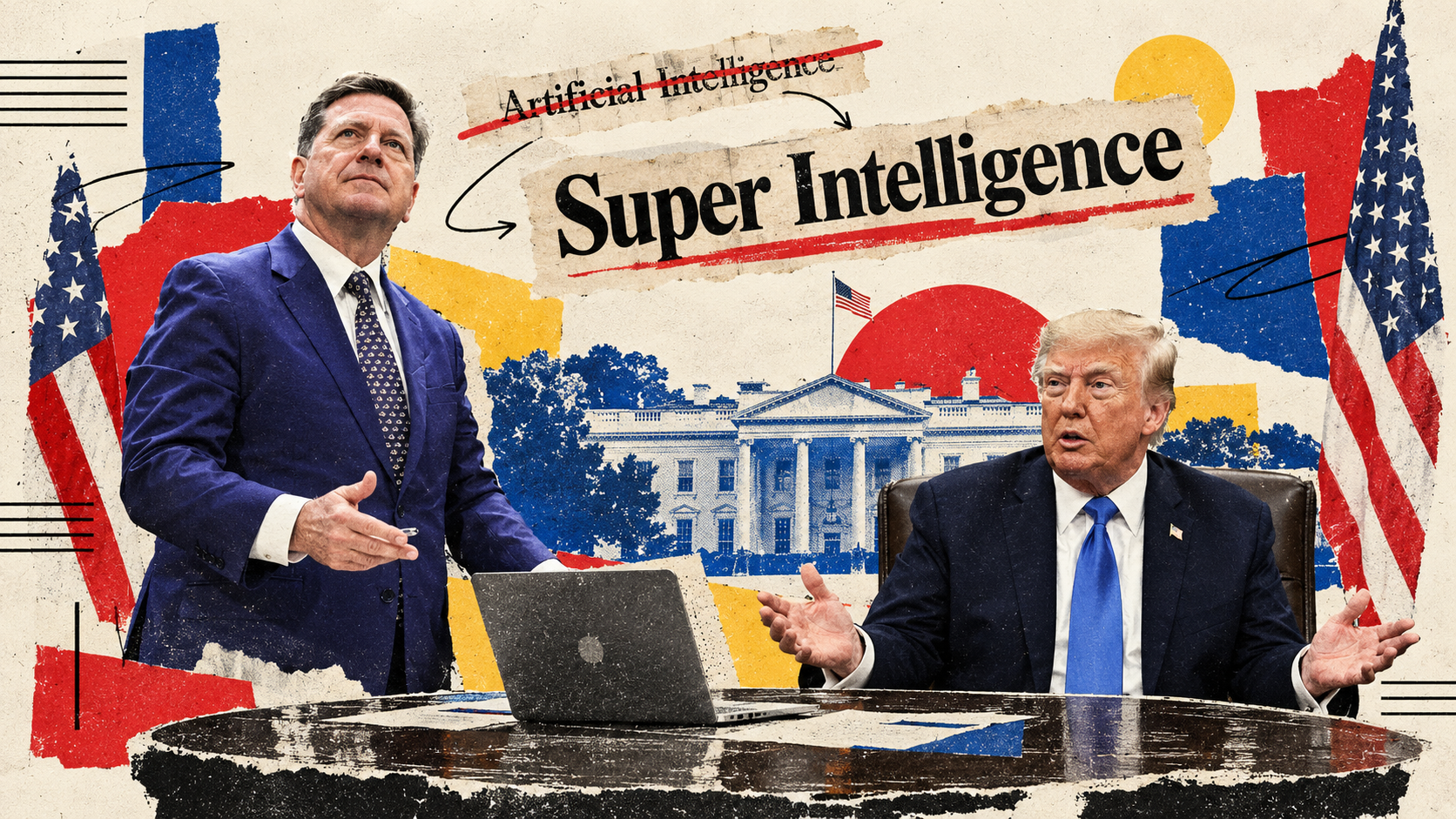
Donald Trump has created a new federal task force charged with coordinating the US government’s response to artificial intelligence, combining national-security, competition and technology officials as Washington tries to maintain its lead over China without imposing broad new restrictions on the industry.
Called “Super Intelligence Force”, the group will be chaired by Director of National Intelligence Jay Clayton. Federal Trade Commission Chair Andrew Ferguson, Pentagon technology chief Emil Michael and Office of Personnel Management Director Scott Kupor will serve as vice chairs. It will report directly to Trump and White House Chief of Staff Susie Wiles.
Despite its futuristic name, this is not a unit developing a new form of superhuman AI. The Trump administration formally ordered federal agencies on September 29 to replace the terms “artificial intelligence” and “AI” with “Super Intelligence” and “SI” in official communications. For now, the executive order explicitly defines “Super Intelligence” using the existing legal definition of artificial intelligence.
The task force has 120 days to assess both the risks and opportunities created by advanced AI and recommend how the federal government should respond. Its charter reportedly calls for plans to address AI-enabled threats while avoiding regulation or regulatory capture that could restrict innovation and competition. Clayton has argued that, in the global AI race, one major danger for the United States is simply “not being first.”
The group is expected to examine issues including cyberattacks, misuse of AI for biological threats, existing regulation and the government’s ability to respond when advanced systems cause incidents. It will also consult technology companies, consumers, public-interest and religious groups, and infrastructure providers.
The Super Intelligence Force is therefore better understood as a high-level coordination body than a new federal agency. Its creation signals that AI safety is becoming a more formal part of US policy, even as the administration continues to argue that excessive regulation could weaken America against China.