

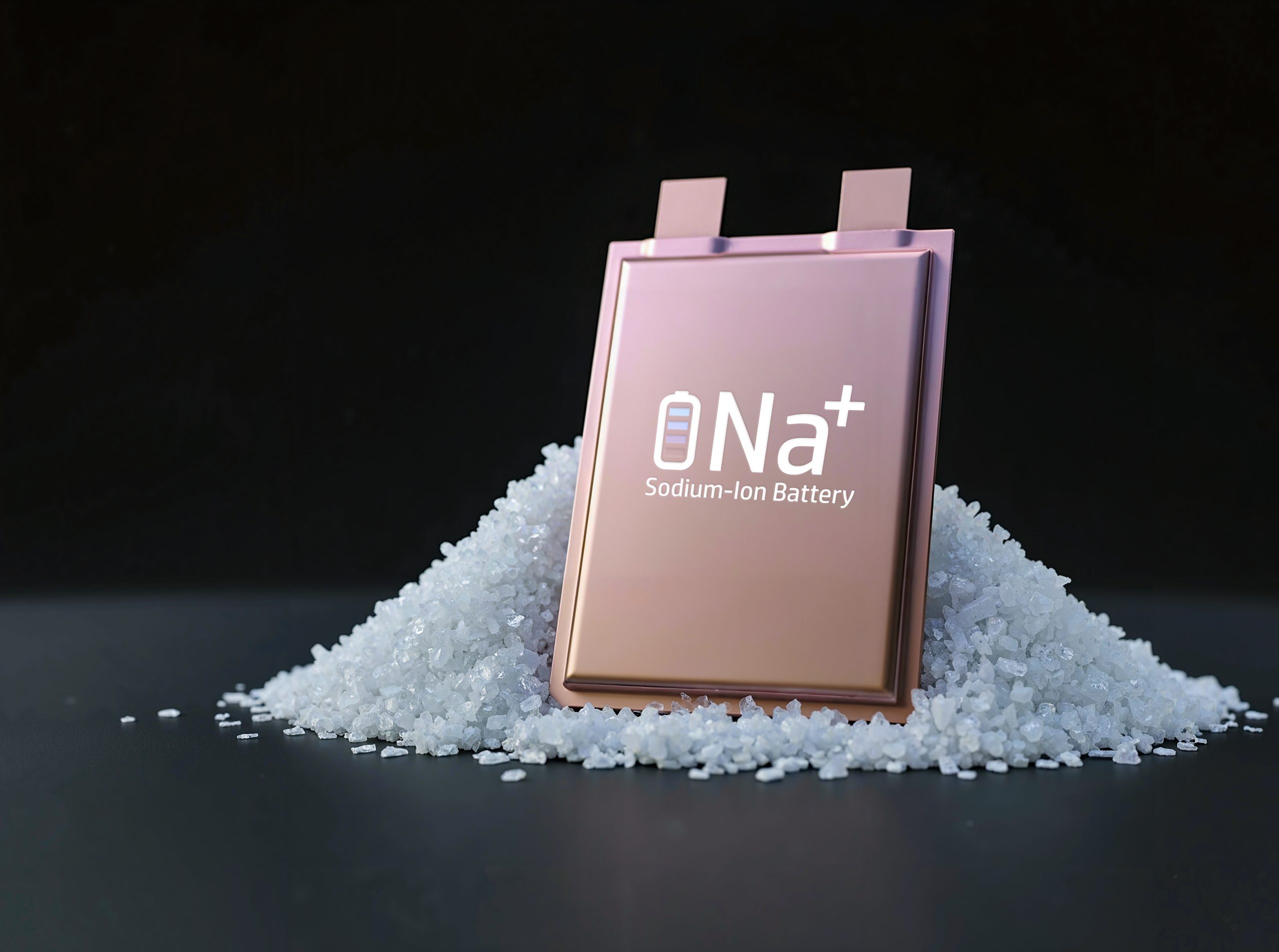
Researchers in China have developed an experimental sodium-metal battery that can charge at an extremely high rate equivalent to a full charge in about four minutes, while addressing one of the technology’s biggest safety and durability problems: the growth of internal metallic structures that can short-circuit the battery.
The work, led by researchers at Southeast University and published in Nano-Micro Letters, replaces the lithium used in conventional with sodium. Sodium is far more abundant, making it attractive for potentially cheaper batteries with less dependence on lithium supply chains.
This is specifically a sodium-metal battery, not the sodium-ion batteries already moving toward commercial production. Its negative electrode uses sodium metal directly, which can improve performance but introduces a serious problem. When a battery charges, sodium can deposit unevenly and form needle-like structures called dendrites. If they grow far enough, they can pierce the material separating the two electrodes and cause a short circuit.
The researchers’ solution is a quasi-solid gel electrolyte, the material through which sodium ions travel between the electrodes. Its structure encourages the sodium ions to move more uniformly while creating protective layers on both electrodes. In laboratory tests, sodium plating and stripping remained stable for more than 6,000 hours without dendrite-induced failure.
The headline result came at a 15C charging rate, theoretically equivalent to charging in four minutes. The full cell still delivered 80.1 mAh per gram of cathode material at that speed. At a slower 3C rate, roughly a 20-minute charge, it retained 90% of its capacity after 2,000 cycles.
Those figures should not be interpreted as a four-minute electric-car battery ready for production. The 2,000-cycle durability test was performed at 3C, not at the four-minute 15C rate. The researchers also built a small pouch-format prototype, but it was tested for only 19 cycles at a much slower rate. The advance therefore solves an important materials problem rather than delivering a finished lithium-ion replacement. Scaling the chemistry, demonstrating competitive energy density and proving long-term safety in large cells remain necessary before it could reach vehicles or grid storage.