

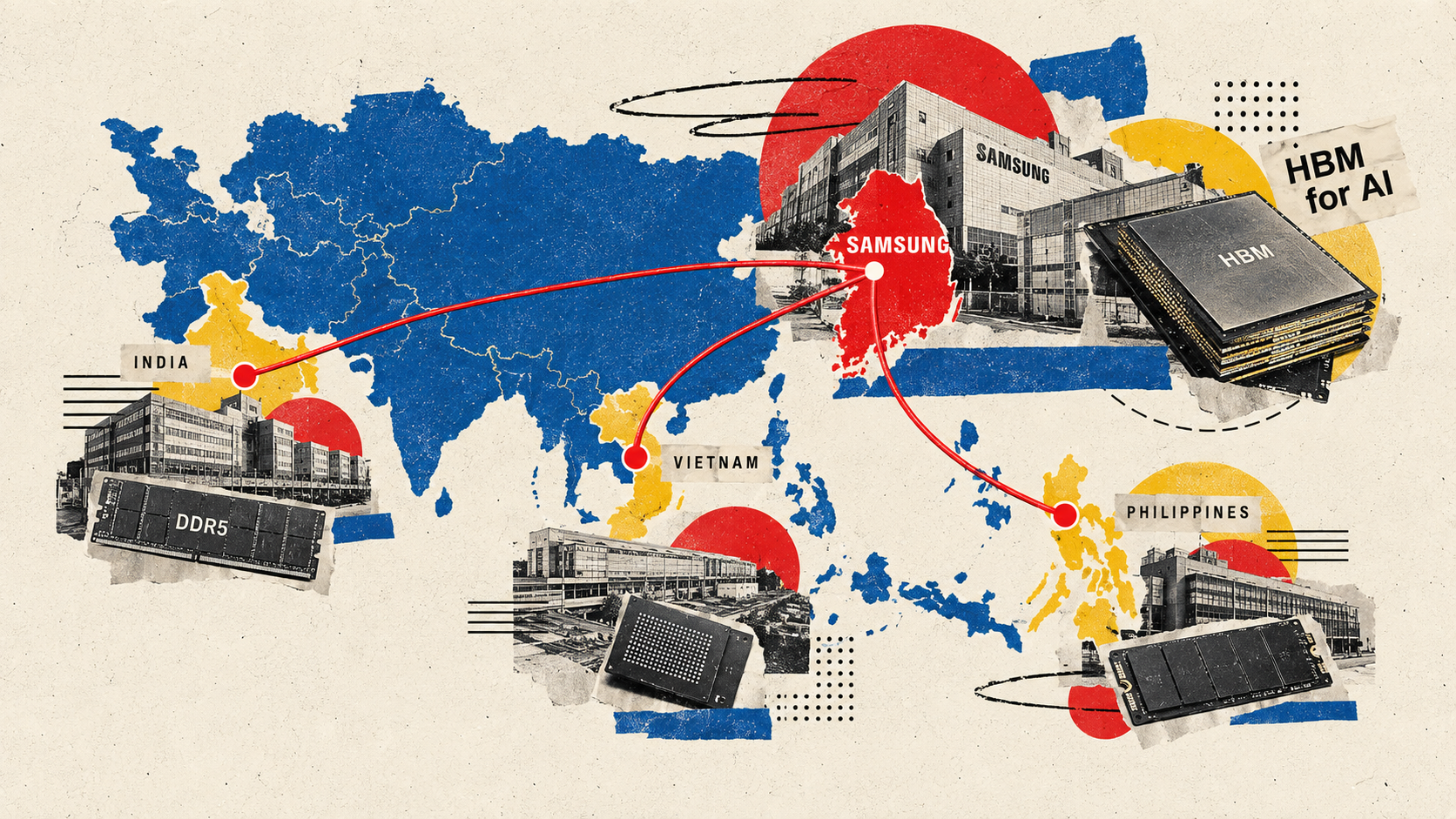
Samsung Electronics is reportedly preparing to rely more heavily on outside manufacturers for additional DDR5 memory modules and SSDs, freeing scarce factory space for the far more complex and more profitable memory required by AI servers.
Let’s be clear, Samsung is not abandoning conventional memory manufacturing. The reported shift mainly concerns the final stages of production: assembling memory chips into DDR5 modules or SSD products, packaging them and testing them. Samsung would continue producing the underlying DRAM and NAND chips while sending more of this comparatively routine “back-end” work to specialist partners.
The reason is HBM, or High Bandwidth Memory. Unlike the RAM found in a typical PC, HBM stacks multiple layers of memory vertically and connects them extremely closely to processors such as AI accelerators. This lets enormous quantities of data move much faster between the processor and memory, something particularly important when training or running large AI models. Manufacturing and packaging HBM is consequently much more demanding than assembling ordinary DDR5 modules.
Samsung says demand for HBM, server DRAM and enterprise SSDs continues to accelerate as companies spend heavily on AI infrastructure. The group began commercial HBM4 production earlier this year and expects its HBM sales to more than triple in 2026 compared with 2025.
But space is now becoming a constraint. Samsung is reportedly reallocating equipment at its Cheonan and Onyang facilities in South Korea toward advanced packaging and is preparing a 6 trillion won (roughly $4.3 billion) HBM facility at Onyang. It is also building a $1.5 billion semiconductor testing plant in Vietnam.
Outside suppliers are expanding accordingly. Dreamtech is preparing its Noida facility in India for more than 50 million memory modules annually, while Hanyang Digitech is increasing automation in Vietnam and SFA Semicon is moving DDR5 assembly and testing equipment to the Philippines.
For PC and server buyers, the strategy could help Samsung keep increasing DDR5 and SSD output without sacrificing capacity for AI products. However, it does not necessarily mean cheaper memory. Samsung itself expects industry supply constraints to continue despite rising production.
Samsung has not formally confirmed the outsourcing strategy described by industry sources. If implemented as reported, it would illustrate how the AI boom is reshaping even the production of conventional computer memory: the most valuable factory space is increasingly being reserved for HBM.