

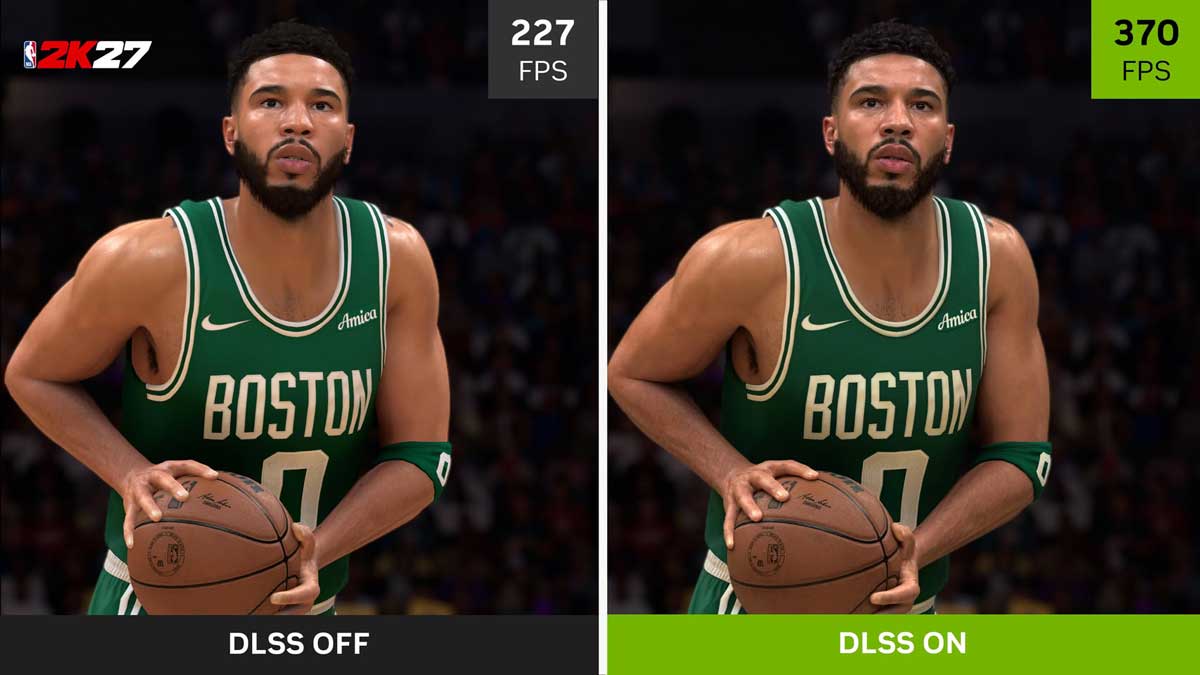
DLSS is crossing a new boundary: instead of merely reconstructing information already defined by the game engine, its neural model can add visual detail that was not present in the original rendered frame. The technology gives developers granular control, but Nvidia says it can reduce frame rates by roughly 50–60% before other DLSS features recover the lost performance. DLSS 5 launches in early September in NBA 2K27 on GeForce RTX 50 GPUs and GeForce Now.
For eight years, Nvidia has largely sold DLSS as a way to get more graphics out of less rendering work. DLSS 5 partially reverses that proposition.
The technology is now available since September 3 with NBA 2K27 on every GeForce RTX 50 desktop and laptop GPU, as well as through the Ultimate tier of GeForce Now. PC users will need Nvidia’s new Game Ready Driver, released at the same time. No other game will officially support DLSS 5 at launch.
But DLSS 5 is not simply another upscaler. Nvidia now calls the technology “3D-Guided Neural Rendering”: a final stage of the graphics pipeline that takes an image already produced by the game engine and runs a neural network over it to enrich lighting and material behavior. It can create deeper contact shadows, change the way light travels through ears or strands of hair, simulate subsurface scattering through skin, enrich reflections and make materials appear more physically complex than would normally be affordable in real time.
The underlying geometry is not supposed to change. A character’s nose, eyes and facial outline remain those built by the developer. But changing shadows, color, reflections and the way light interacts with skin can dramatically change how that same geometry is perceived. That is where the controversy begins.
From reconstructing pixels to generating detail the rendered frame did not contain
The original DLSS arrived alongside RTX GPUs in 2018, using machine learning to reconstruct higher-resolution imagery from cheaper rendering. DLSS 2 in 2020 greatly improved temporal reconstruction by combining information across frames with engine motion vectors. DLSS 3 added Frame Generation in 2022, synthesizing an entire frame between conventionally rendered ones. DLSS 4 arrived with RTX 50 hardware in 2025 and introduced Multi Frame Generation, initially creating as many as three additional frames for every traditionally rendered frame, while transformer models upgraded Super Resolution and Ray Reconstruction. DLSS 4.5 later pushed that to as many as five generated frames for each rendered one.
DLSS 5 crosses a different boundary. Those earlier technologies largely tried to reconstruct information the engine had already defined. DLSS 5 can generate richer visual information than exists in the initial rendered image. Nvidia says the runtime model receives information including frame color and motion vectors. Its training teaches it to understand graphics concepts such as surface albedo, normals, lighting and materials. The model then interprets what it sees — skin, hair, clothing, foliage and objects — and infers more lifelike material and lighting interactions.
Calling DLSS 5 merely “upscaling” is therefore increasingly inaccurate. The engine remains the geometric foundation, but a neural model interprets the image before the player sees it.
Two sliders can radically change the result
After the hostile reaction to Nvidia’s first demonstrations in March, the company is putting far more emphasis on developer control. DLSS 5 exposes two major adjustment dimensions. “Structure intensity” influences features including ambient occlusion, contact shadows, reflections and subsurface scattering. “Tone intensity” controls broader lighting and color characteristics.
There are also three model variants, labelled “default,” “cinematic” and “natural” in the tools. More importantly, studios can mask individual parts of the image. Developers can also explicitly protect parts of a scene from neural modification.
Back at GTC in March, Nvidia demonstrated DLSS 5 on games including Resident Evil Requiem, Starfield, EA Sports FC and Hogwarts Legacy. Some examples were quickly mocked online, particularly the altered appearance of Resident Evil protagonist Grace Ashcroft, whose face looked less like an enhanced version of the original asset and more like the result of an aggressive generative filter. Five months later, none of those games is launching with the technology. Nvidia did not tell when DLSS 5 will arrive in another title or reconfirm that every game mentioned will still ship with it.
Nvidia nevertheless described DLSS 5 as its most important computer-graphics breakthrough since real-time ray tracing debuted in 2018. Jensen Huang called it a “GPT moment for graphics.”
NBA 2K27 is a much more controlled test case
The first commercial implementation is therefore more conservative. Visual Concepts is using DLSS 5 in NBA 2K27 largely to resemble a television broadcast populated by real humans, with skin, hair, uniforms and highly predictable arena lighting. In demonstrations, the changes were considerably less aggressive than Nvidia’s March examples. Players generally gained more convincing material and lighting detail instead of looking like different AI-generated people. Yet pushing the settings too far can still age a face, hollow out cheeks or make hair appear greyer even though the underlying geometry has not moved. DLSS 5 can technically preserve a character model while materially changing its art direction.
The graphics enhancement can cut performance in half
DLSS 5 has another paradox: it is computationally expensive. The technology has historically been marketed as a performance multiplier, but Neural Rendering itself carries a very large cost. Nvidia estimates a roughly 50–60% performance hit before other DLSS features compensate for it.
Nvidia’s March demonstrations required two RTX 5090 GPUs. The company says it has improved DLSS 5 performance fivefold since then and can now run the model at up to 4K on a single RTX 50 GPU. Nvidia says even a midrange RTX 5060 can run NBA 2K27 at 1080p with Ultra settings, ray tracing and DLSS 5, but doing so assumes a very fast CPU and 6X Multi Frame Generation. In that mode, the game produces one traditionally rendered frame while AI generates the other five displayed frames.
On an RTX 5090, Nvidia claims up to 370fps at 4K Ultra with ray tracing when combining DLSS 5 with Super Resolution and Multi Frame Generation. At 1440p, its figures rise to as much as 590fps on the RTX 5090, 410fps on the RTX 5080, 350fps on the RTX 5070 Ti and 260fps on the RTX 5070. These are Nvidia measurements for the complete DLSS stack, not native rendering performance or the isolated cost of Neural Rendering.
The architecture is almost circular: Nvidia spends substantial GPU compute making each image more visually sophisticated, then uses other neural models to reconstruct resolution and manufacture enough additional frames to recover (and potentially far exceed) the lost frame rate.
Modders have already demonstrated both the promise and the problem
DLSS 5 escaped into the wild before its official release when a Neural Rendering library from an early version of NBA 2K27 was extracted. RenoDX modders rapidly injected it into games including Control, Skyrim, Cyberpunk 2077, GTA V and Shadow of the Tomb Raider. The experiments have produced some of the strongest arguments both for and against the technology. Old materials, jewelry, streets, clothing and lighting can gain remarkable depth. Apply the same enhancement aggressively to a face that was never designed for it, and the character can look distinctly wrong.
Modders have even patched the leaked implementation to run on some RTX 40 GPUs by replacing Blackwell-specific code paths. That does not mean Nvidia will offer official support: DLSS 5 remains an RTX 50-only feature at launch.
Those experiments reveal the bigger shift. Since DLSS 1, Nvidia has asked players to accept that increasingly large portions of the final image are not conventionally rendered. DLSS 5 asks a different question: how much interpretation can be handed to a neural network before a technical enhancement becomes an aesthetic modification?
Nvidia’s answer is that artists remain in control. NBA 2K27 is the first real test of that claim. If it works, DLSS 5 could eventually become another normal stage of the rendering pipeline, just as AI upscaling and generated frames did before it. If it does not, the problem will be bigger than artifacts or lost performance: it will be whether players and developers want an AI model deciding what a finished game should look like at all.