
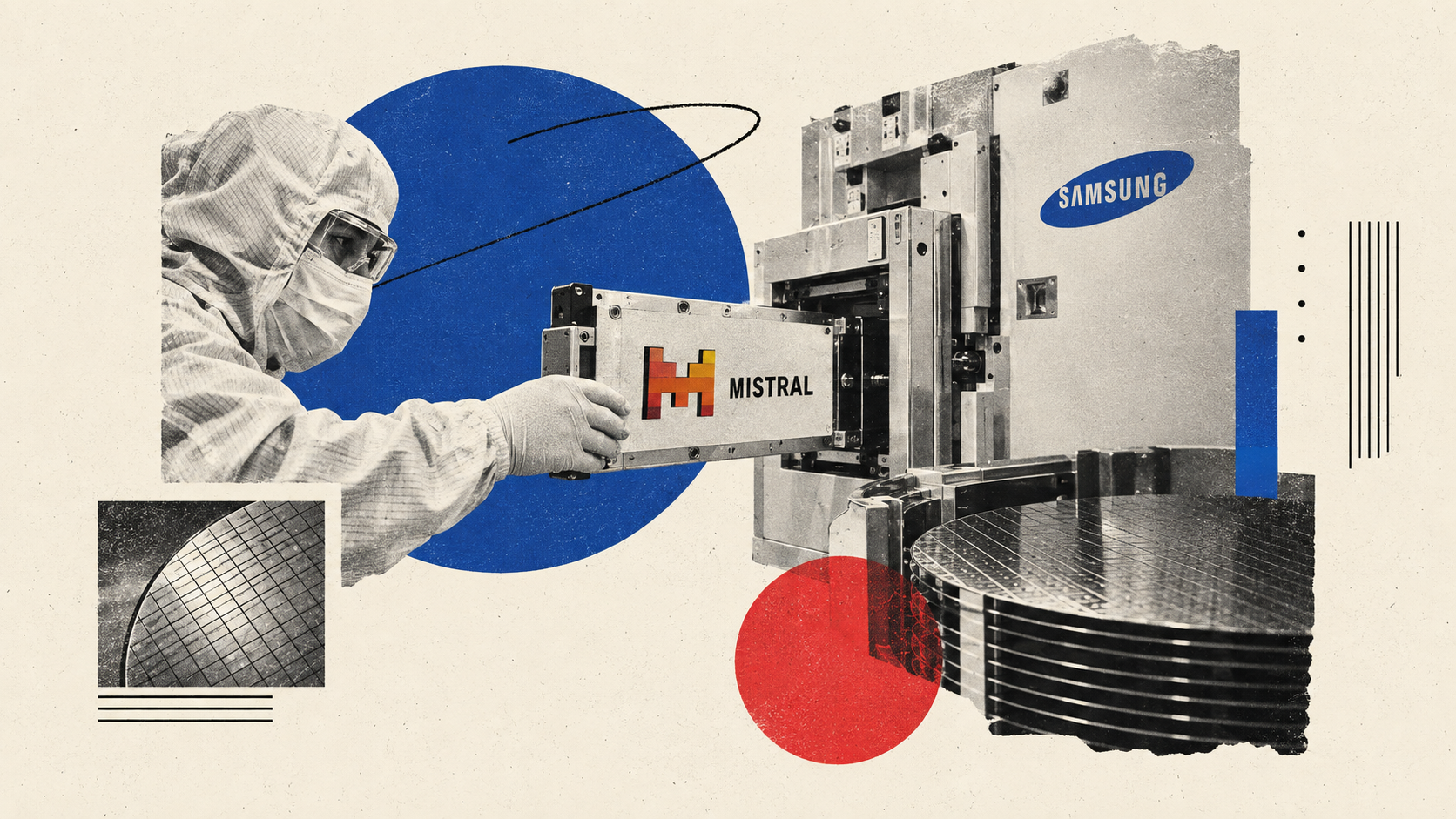
Samsung has led Mistral’s €3bn funding round while simultaneously signing a deal to deploy the French company’s AI inside its semiconductor operations. The combination reveals why Mistral’s on-premise, customisable AI strategy is attracting industrial groups that need advanced models without surrendering control of sensitive data.
Mistral raised €3 billion in a Series D at a post-money valuation above €21 billion on September 8. The French AI company says Samsung led the round, with the Scaleup Europe Fund managed by EQT and existing investor PSG Equity joining as co-leads. Samsung has described its participation as a strategic equity investment but has not disclosed the size of its individual cheque.
The more revealing part of the transaction is what Samsung intends to do with Mistral’s technology.
Mistral is going inside Samsung’s chip operations
Samsung and Mistral have signed a strategic partnership covering the Korean group’s semiconductor business. Samsung plans to use Mistral Large and other Mistral technologies to build customised AI systems for its Device Solutions division, which covers memory, logic and foundry operations.
Crucially, those systems are intended to run on-premise, inside Samsung’s own infrastructure rather than requiring sensitive information to be processed through an external cloud. Samsung says this will allow proprietary semiconductor technology and operational data to remain within its systems.
That matters in chip manufacturing, where process recipes, yield information, defect data and equipment behaviour can contain commercially critical intellectual property.
Samsung plans to apply the models to areas including factory data analysis, defect detection, equipment optimisation and process improvement. The company says the objective is to shorten development cycles, improve manufacturing precision and stabilise yields more quickly across advanced memory and logic production. The investment therefore creates a relationship in which Samsung is simultaneously Mistral’s shareholder, customer and industrial development partner.
Sovereignty here is as much corporate as geopolitical
Mistral has increasingly positioned itself around “sovereign” AI: systems that organisations can customise and operate with greater control over models, infrastructure and data. For governments, that language is often associated with reducing reliance on US or Chinese technology. For Samsung, the more immediate attraction appears operational.
A semiconductor manufacturer does not necessarily need an AI supplier to be European. It does, however, have a strong reason to favour an architecture that can be deployed within controlled infrastructure and adapted to highly specialised industrial data. That makes Mistral’s sovereignty pitch relevant far beyond European public policy. It becomes an enterprise proposition for sectors where sending proprietary data to a third-party cloud may be undesirable or impossible.
The same logic was visible in Mistral’s previous major funding round. In September 2025, semiconductor-equipment leader ASML led a €1.7 billion Series C at an €11.7 billion post-money valuation while establishing its own strategic partnership with Mistral around engineering and industrial applications. Samsung now extends that pattern deeper into the semiconductor value chain.
This is not Samsung choosing Mistral instead of OpenAI
The deal should not be interpreted as Samsung abandoning US AI platforms in favour of a European alternative. Samsung has simultaneously expanded its relationship with OpenAI. ChatGPT Enterprise and Codex were rolled out to all Samsung Electronics employees in Korea and to Device eXperience staff globally in 2026, while Samsung is also supplying memory technologies for OpenAI’s infrastructure projects.
The more plausible interpretation is diversification. Different AI systems are being assigned to different parts of Samsung’s stack: general-purpose productivity tools for employees, infrastructure partnerships around chips and data centres, and specialised on-premise models for industrial environments where data control matters most.
For Mistral, that distinction could be strategically important. Competing head-on with the largest US labs purely on consumer chatbot adoption or frontier-model scale is expensive. Becoming the model and infrastructure provider embedded inside banks, manufacturers, governments and other organisations with demanding security requirements creates a different route to scale.
Mistral says the new €3 billion will fund frontier research, additional computing capacity, infrastructure and international expansion. But Samsung’s investment provides something that capital alone cannot: a large industrial environment in which Mistral can demonstrate that its sovereignty strategy translates into operational value.
The next test is therefore not simply whether Mistral can train a stronger model. It is whether Samsung can show that customised, privately deployed AI measurably improves one of the world’s most complex manufacturing systems.
[…] READ ALSO : Why Samsung backed Mistral: the strategy goes beyond AI sovereignty […]
[…] READ ALSOWhy Samsung backed Mistral: the strategy goes beyond AI sovereignty→ […]
[…] READ ALSOWhy Samsung backed Mistral: the strategy goes beyond AI sovereignty→ […]