
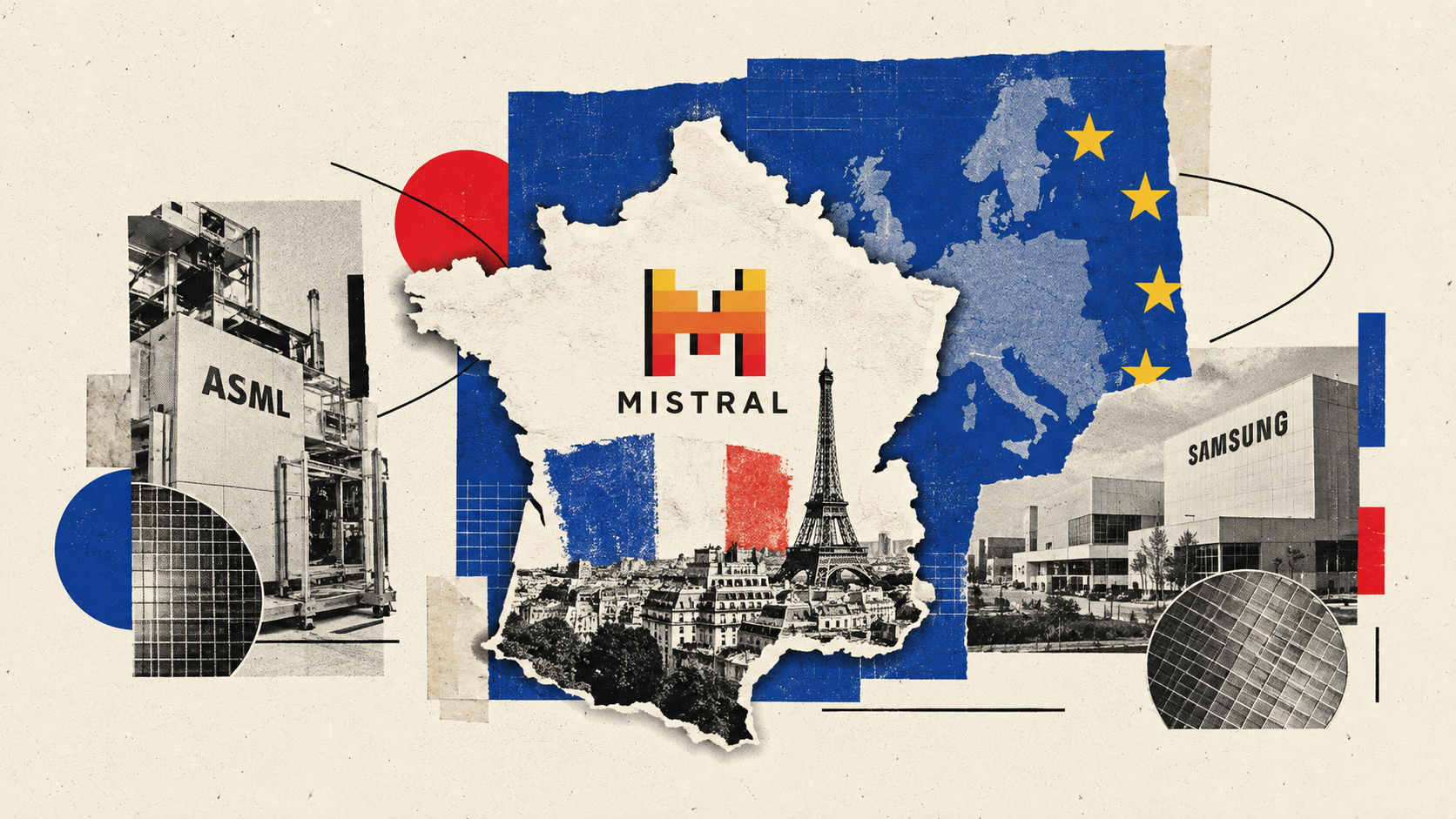
Mistral AI remains a French company headquartered and incorporated in Paris, but the capital behind Europe’s most prominent AI challenger has become increasingly international. After a €3 billion Series D led by Samsung, understanding whether Mistral is still “French” requires separating legal identity, shareholder ownership, governance and technological sovereignty.
NOTE : Mistral AI is still a French company. That part is straightforward. The company is incorporated as a French SAS, registered in Paris under number 952 418 325, with its headquarters at 15 rue des Halles. Its three founders (Arthur Mensch, Guillaume Lample and Timothée Lacroix) remain its senior executives (French business registry).
What has become far more international is the money behind it.
Mistral’s €3 billion Series D in September 2026 brought Samsung Electronics, a European scale-up fund, global private-equity firms, asset managers and a sovereign European state into an already unusually diverse shareholder base. Mistral now has investors from Europe, North America and Asia, making the shorthand description of the company as simply a “French AI champion” increasingly incomplete.
Mistral was internationally financed from the beginning
The pattern did not start with Samsung. Mistral’s first financing round in June 2023 raised more than €105 million only weeks after the company was created. The round was led by US venture-capital firm Lightspeed Venture Partners, although French investors including Bpifrance and entrepreneurs also participated.
Six months later, Mistral raised €385 million in Series A financing led by Andreessen Horowitz. Lightspeed reinvested, while other investors included Salesforce Ventures and French financial interests. The round pushed Mistral’s valuation to around €2 billion.
The internationalisation accelerated in June 2024. A €600 million Series B led by General Catalyst included €468 million in equity and €132 million in debt. Investors included Andreessen Horowitz, Lightspeed, Bpifrance, BNP Paribas, Nvidia, Salesforce Ventures, IBM, Cisco, Samsung Venture Investment Corporation, Eurazeo, Korelya Capital, Hanwha Asset Management and Saudi-backed Sanabil Investments, among others. By then, Mistral was already neither financially French nor financially American. Its capital had become deliberately global.
ASML changed the scale of the shareholder base
The most important individual investment before 2026 came from Dutch semiconductor-equipment manufacturer ASML. In September 2025, Mistral raised €1.7 billion at an €11.7 billion post-money valuation. ASML invested €1.3 billion as lead investor and said the transaction gave it approximately 11% of Mistral on a fully diluted basis. That figure is significant because it is one of the few major ownership percentages publicly confirmed by an investor itself.
It should not, however, be treated as ASML’s current 2026 holding. ASML participated again in Mistral’s latest round, but Mistral has not published a post-Series D cap table showing how dilution and new subscriptions affected each shareholder.
This is also why broader estimates of Mistral’s ownership need caution. Some experts estimate that the three founders held roughly 35.5% before the latest financing and that French founders and investors together represented more than 62%. Those figures may help illustrate the structure before the latest round, but they are not a company-published September 2026 ownership statement.
Samsung adds another industrial shareholder
Mistral announced on September 8 that it had raised another €3 billion at a post-money valuation exceeding €21 billion. According to Mistral, Samsung Electronics led the Series D, with the EQT-managed Scaleup Europe Fund and existing investor PSG Equity as co-leads. New investors included Advent, funds and accounts managed by BlackRock and the Grand Duchy of Luxembourg.
Existing investors participating again included ASML, Andreessen Horowitz, Bpifrance, BNP Paribas CIB, Carmignac, DST Global, Eurazeo, General Catalyst, Headline, Index Ventures, Korelya Capital, Lightspeed, Nvidia and Salesforce Ventures.
There is a reporting discrepancy worth preserving: Reuters described PSG Equity as leading the round, while Mistral itself, the Financial Times and the Wall Street Journal identified Samsung as the lead investor. The primary company announcement provides the strongest basis for describing the formal structure of the transaction.
Samsung’s involvement is also industrial rather than purely financial. It has separately agreed to use customised Mistral systems inside its semiconductor operations, following the model established by ASML a year earlier. Mistral is therefore increasingly attracting shareholders that are simultaneously technology partners and potential major customers.
Foreign capital does not automatically mean foreign control
This is where the distinction between ownership and control becomes important. During a French parliamentary hearing in May 2026, Arthur Mensch said venture-capital firms accounted for less than 30% of Mistral’s capital at the time. He also said Bpifrance held a board seat and argued that using foreign capital was acceptable provided control and governance remained protected. Asked directly whether an American company could one day buy Mistral, Mensch said the company’s objective was to remain independent and eventually pursue a public listing rather than sell itself.
Those statements came four months before the €3 billion Series D, however. They describe Mistral’s governance philosophy, not a verified post-round percentage of founder voting rights. Without Mistral publishing its current shareholder agreement, voting-right structure and fully diluted cap table, it is not possible to state precisely how much economic ownership or voting power is currently French.
“French company” and “sovereign AI” are different questions
The debate also becomes misleading when nationality and sovereignty are treated as synonyms. Mistral itself now defines sovereign AI mainly through control of technology: organisations should be able to keep their data within their own boundaries, customise and control models, use private and predictable compute, and audit the systems they put into production.
Under that definition, an AI company can have international shareholders while still offering infrastructure designed to reduce customers’ dependence on external platforms. The counterargument is economic. Foreign shareholders still acquire rights to future financial returns and, depending on the investment agreements, may gain governance rights or influence. Mensch acknowledged this tension himself before the French parliament, noting that part of the economic return generated by foreign venture capital ultimately leaves Europe.
French lawmakers are sufficiently concerned that a parliamentary inquiry has discussed giving the state a “golden share” in Mistral, which could provide special blocking rights over sensitive capital decisions.
So, is Mistral still French?
Legally, yes. Operationally and in leadership, yes: Mistral remains headquartered in France and founder-led. Financially, the answer is much less national. Its shareholder base includes French public and private capital, European institutions and industrial groups, US venture and private-equity firms, global asset managers and Asian strategic investors.
What cannot currently be established from public evidence is the precise nationality breakdown of the post-Series D cap table. That distinction matters. Mistral has not ceased to be French because Samsung, ASML, BlackRock or Andreessen Horowitz own shares. But neither can “French company” be used as shorthand for “French-owned company.”
The more useful question for Europe is whether Mistral can continue to raise the billions required to compete globally without surrendering strategic control over the technology, infrastructure and corporate decisions that make it valuable.