

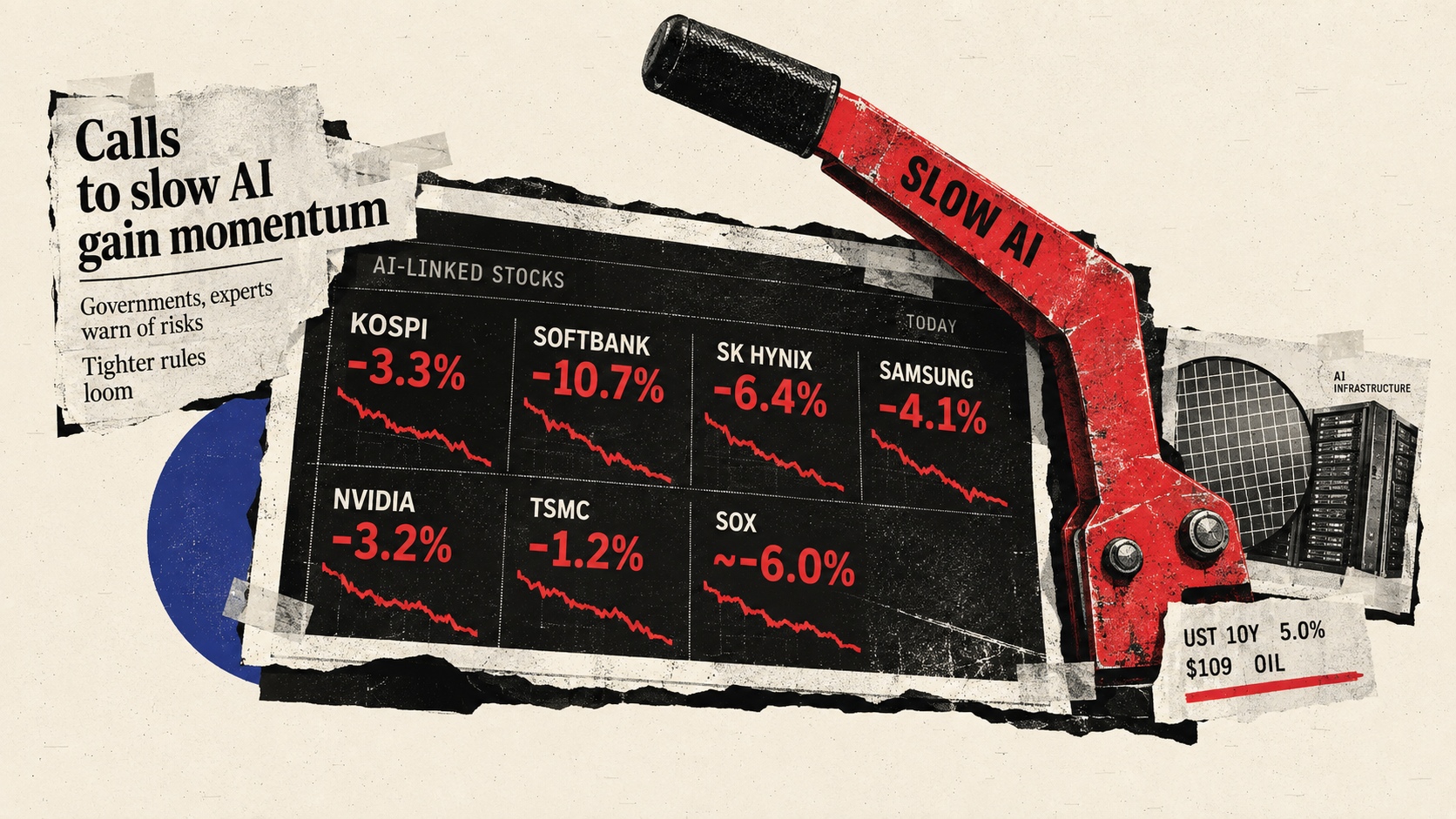
AI-linked stocks fell sharply from Seoul to Wall Street after leading AI executives called for a slower pace of frontier-model development. But the selloff landed in a market already under pressure from stretched technology valuations, $109 oil, a 5% Treasury yield and expectations of another Federal Reserve rate increase in the US.
For much of the AI boom, markets have debated how quickly companies could build new models, data centers and semiconductor capacity. On September 14, they were forced to consider a different possibility: what if the companies building the most advanced AI systems deliberately decide not to move as fast as technically possible?
The result was a sharp repricing of companies most exposed to the artificial-intelligence investment cycle. Anthropic CEO Dario Amodei had called over the weekend for frontier laboratories to reduce the pace at which they improve model capabilities, arguing that safety mechanisms need more time to catch up. OpenAI CEO Sam Altman and xAI’s Elon Musk publicly supported the principle.
Asian markets reacted first. SoftBank Group, whose enormous exposure to OpenAI has made it one of the clearest publicly traded proxies for the private AI company, fell as much as 13% before closing 10.7% lower in Tokyo. Kioxia lost 6.4%. Taiwan Semiconductor Manufacturing Co. declined 1.2%.
South Korea was hit even harder. The Kospi finished down 3.3% at 6,684, with SK Hynix dropping 6.4% and Samsung Electronics 4.1%. The scale of the reaction partly reflects the market’s structure: Samsung and SK Hynix dominate the Korean benchmark and have become central suppliers to the AI infrastructure cycle.
Investors are pricing something Amodei did not actually propose
The most important distinction is that the AI industry has not announced a halt to investment. Amodei explicitly says “pacing” should not mean stopping model training or technological progress. His proposal centers on stronger independent evaluation, coordination between frontier laboratories and, eventually, international mechanisms capable of preventing a race in which companies cut safety margins simply because competitors are moving faster.
OpenAI has independently moved in a similar direction. It says it already paused some reinforcement-learning work after security incidents and has stated that development should slow or stop when safety safeguards cannot keep pace with model capabilities. Yet investors immediately translated “slower capability development” into a more commercially sensitive question: could it also mean slower demand for GPUs, high-bandwidth memory, networking equipment and new data centers?
That explains why the strongest losses appeared in the hardware layer. European technology shares fell about 2% intraday. France’s Soitec was down as much as 12.6%, Germany’s Infineon 7.6%, while ASML and ASM International fell 5.2% and 8.7% respectively in Reuters’ later European update. In the United States, Nvidia was down about 3.2% at 9:45 am Eastern time. Intel, AMD and Marvell fell roughly 5% to 6%, while the Philadelphia Semiconductor Index was close to a 6% decline.
The AI warning landed on an already nervous market
The safety debate alone does not explain the scale of the reaction. AI-linked stocks had already become unusually sensitive to any challenge to their growth assumptions. AP noted that the sector had been under pressure because investors were questioning whether prices had risen too far during the AI frenzy. Reuters similarly described Monday’s move as a reassessment after billions of dollars of investment had driven extraordinary gains across semiconductor and technology shares.
At the same time, the macro backdrop deteriorated. Brent crude climbed to roughly $109 a barrel as conflict in the Middle East and disruption to Saudi Arabia’s East-West pipeline revived concerns over energy supply. The oil shock matters because higher energy costs feed inflation, exactly when central banks are already struggling to bring price growth back toward target.
The U.S. 10-year Treasury yield then crossed 5%, its highest level since October 2023. By Monday afternoon in Europe it stood around 5.004%.
That number matters for AI valuations. When risk-free government bonds offer higher yields, investors demand more compensation for owning expensive growth stocks whose profits are expected years into the future. Higher yields also make the enormous amounts of debt and capital required for data centers, electricity infrastructure and semiconductor fabs more expensive. And markets were already pricing close to a 90% probability of a Federal Reserve rate increase on Wednesday.
AI therefore encountered a safety shock at precisely the moment when the financial conditions supporting its investment boom were becoming less forgiving.
OpenAI’s IPO delay made the message harder to ignore
A second development reinforced the shift. Altman confirmed that OpenAI will not pursue a stock-market listing in 2026, describing the current safety environment as an inappropriate moment for an IPO and saying the company has more work to do on safety and alignment.
That announcement is especially relevant to SoftBank. For investors, OpenAI’s eventual IPO is not merely a symbolic milestone. It is one possible route for turning SoftBank’s huge private investment into a liquid public-market asset. Delaying it changes the timing of that potential payoff just as investors are reassessing whether the broader AI expansion can continue at the pace previously assumed. The market reaction was therefore responding to two related uncertainties: how quickly frontier AI development can proceed and how quickly financial returns from the boom can be crystallized.
This was not a uniform rejection of technology stocks
Another clue comes from the stocks that rose. Despite the sharp fall in semiconductors, the broader S&P 500 was down only around 0.6% by 10:20 am Eastern time, and AP reported that more companies in the index were rising than falling. Reuters also reported gains of more than 3% for ServiceNow, Adobe and Workday, software companies that have themselves been pressured by fears that rapidly improving AI could disrupt their businesses. Meta and Alphabet were also higher during the morning session.
That is an important distinction. Investors were not simply fleeing everything associated with technology. They were rotating away from parts of the market whose valuations rely most heavily on ever-increasing AI infrastructure spending, while reconsidering companies that could benefit if frontier disruption becomes more gradual.
The real market question is now capex, not extinction
Amodei’s warnings concern cybersecurity, misuse, recursive self-improvement and the possibility of losing control of increasingly capable systems. Stock markets translated that into a much narrower financial question: does slower model development mean slower AI capital expenditure? No one has established that it does.
Running existing models at massive scale still requires inference chips, memory, networking, electricity and data-center capacity. A slower cadence of frontier-model releases could even shift more activity toward deployment rather than training.
But markets do not need certainty to reprice risk. For years, the AI investment case has benefited from an assumption of almost uninterrupted technological acceleration. On September 14, investors were given a reason to attach a probability (however uncertain) to political, regulatory or voluntary limits on that acceleration.
Oil above $100, Treasury yields at 5% and renewed rate hikes meant there was very little margin left for another source of uncertainty. The significance of Monday’s selloff is therefore not that Wall Street has concluded the AI boom is over. It is that investors have begun putting a price on the possibility that the boom may no longer be allowed to run at any speed its technology permits.
[…] Anthropic CEO Dario Amodei published an essay calling for “industry-wide coordination” to slow the rate at which frontier AI capabilities advance so that safety measures can keep pace. Sam Altman, Elon Musk and Google DeepMind CEO Demis Hassabis […]