

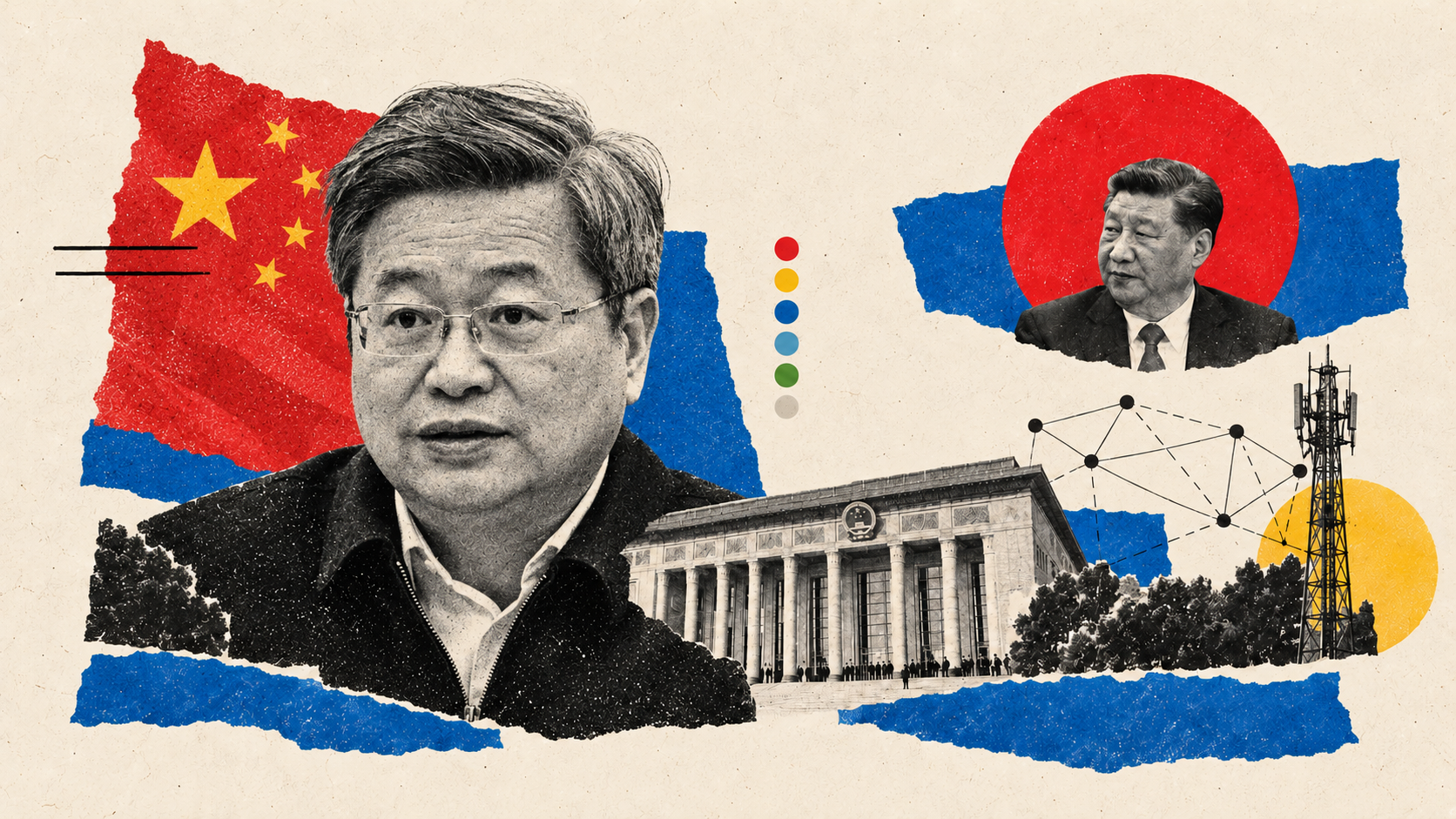
China’s top intelligence official has identified six major AI risks, including cyberattacks, political destabilization, data leakage and military disruption, while explicitly naming advanced U.S. models. Beijing’s position is more nuanced than a rejection of AI safety: it increasingly accepts the risks, but resists arguments that could leave Washington controlling the pace of the global AI race.
State Security Minister Chen Yixin used a signed article published on September 13 in China Cyberspace magazine to set out six categories of risk that Beijing believes increasingly capable AI systems could create. They range from political manipulation and cyberattacks to data leakage, technological dependency, disruption of social governance and military transformation.
The publication matters because of who is making the argument. Chen heads China’s Ministry of State Security, the country’s principal civilian intelligence and counterintelligence agency. His intervention is therefore not simply another regulatory statement about AI safety: it places the technology inside Beijing’s wider understanding of regime security, strategic rivalry and technological sovereignty.
It also came just as some of the most prominent executives in the U.S. AI industry were making a very different case for caution. Anthropic CEO Dario Amodei has called for frontier AI developers to deliberately moderate the rate at which they increase model capabilities, arguing that safety systems and independent evaluations need time to catch up. OpenAI CEO Sam Altman and Elon Musk backed important elements of that argument.
The simultaneous warnings create an unusual point of convergence between Beijing and Silicon Valley. But they are worried about different things.
Beijing’s six-part AI threat model
Chen’s first concern is explicitly political. He warned that deepfakes, AI-generated content and automated online influence operations could be used by what he described as hostile forces to manufacture political rumors, amplify social divisions and conduct what China calls “public-opinion” and “cognitive” warfare. In Chen’s formulation, such activity could threaten China’s political, institutional and ideological security.
His second category concerns cybersecurity. Chen argued that increasingly capable models are making vulnerability discovery, malware development and the automation of attack chains easier and cheaper. He specifically named Anthropic’s Claude Mythos and OpenAI’s GPT-5.5-Cyber as examples of the technological shift.
That claim needs an important qualification. Chen did not provide evidence that either model had been used to attack Chinese critical infrastructure. His argument was about their capabilities and the lower technical barrier they could create for future attackers, not a documented intrusion involving the models.
The remaining four risks broaden the picture. Chen warned that Chinese users could expose sensitive information by feeding it into foreign AI systems; that technological monopolies and export controls could widen the gap between countries; that AI could disrupt established mechanisms of social governance; and that artificial intelligence is becoming increasingly central to military intelligence, targeting, decision support and battlefield operations.
Taken together, the six categories reveal something important about Beijing’s concept of AI safety. It is not primarily organized around an autonomous superintelligence escaping human control. It begins with state security.
China is not denying that AI can become dangerous
That difference should not be confused with China dismissing technical AI risk altogether.
At the World Artificial Intelligence Conference in Shanghai in July, President Xi Jinping called for stronger risk awareness, technical monitoring, early-warning systems and emergency-response mechanisms. He said artificial intelligence should remain “always under human control.”
China has also increasingly incorporated AI into cybersecurity regulation and safety policy. Reuters reported this week that Beijing is preparing technical and regulatory measures aimed at systems that could behave outside their intended boundaries, including mechanisms allowing developers to intervene when models act unexpectedly.
The divide between Beijing and parts of the U.S. AI industry is therefore not simply “AI is dangerous” versus “AI is safe.”
It is a disagreement about which risks take priority and what political consequences should follow from them.
Beijing rejects the part of the safety argument that constrains China
Asked about calls from Amodei, Altman and Musk to slow frontier development (and about Amodei’s argument that a Chinese AI lead could create serious security risks), Foreign Ministry spokesperson Guo Jiakun rejected what he called “fear-mongering, confrontation and vicious competition.” Guo said countries should instead promote open, inclusive and beneficial AI development and warned against turning safety concerns into strategic confrontation.
The response makes sense when Amodei’s complete argument is considered. His proposal is not limited to slowing model capabilities. He also argues that democratic countries should preserve a substantial technological lead, that advanced chip controls on China should remain tight and that international pacing will eventually require some form of cooperation with Beijing.
From Beijing’s perspective, those elements make it difficult to separate safety policy from technological containment. China can therefore warn that AI threatens its infrastructure and political stability while simultaneously rejecting American warnings about Chinese AI development.
The two positions are not logically incompatible. Beijing accepts risk management. It rejects a framework in which the United States determines which countries may possess the most advanced capabilities.
AI safety is becoming part of the U.S.-China power struggle
AI safety is no longer only a debate between researchers over alignment, autonomous agents or hypothetical superintelligence. It is increasingly merging with export controls, cybersecurity, military competition, information warfare and industrial policy.
The overlap between Chinese and American concerns is nevertheless striking. Both sides now publicly discuss cyber misuse. Both recognize the possibility of increasingly autonomous systems behaving in dangerous ways. Both support stronger evaluation and governance mechanisms. Both also insist that losing technological ground to the other side would itself create security risks.
That creates a difficult strategic problem. The risks that might justify cooperation are the same risks each side can use to justify maintaining an advantage over the other.
Chen Yixin’s warning therefore does not show Beijing joining Silicon Valley’s campaign to slow frontier AI. It shows something arguably more consequential. AI safety has become part of the language of national power on both sides of the U.S.-China rivalry.
[…] READ ALSOChina’s Spy Chief Puts AI Risk at the Heart of National Security→ […]
[…] models. Beijing portrays U.S. restrictions as an attempt to preserve an AI monopoly and has begun describing advanced American models themselves as potential threats to Chinese critical infrastructure and political stability. Yet officials from […]