

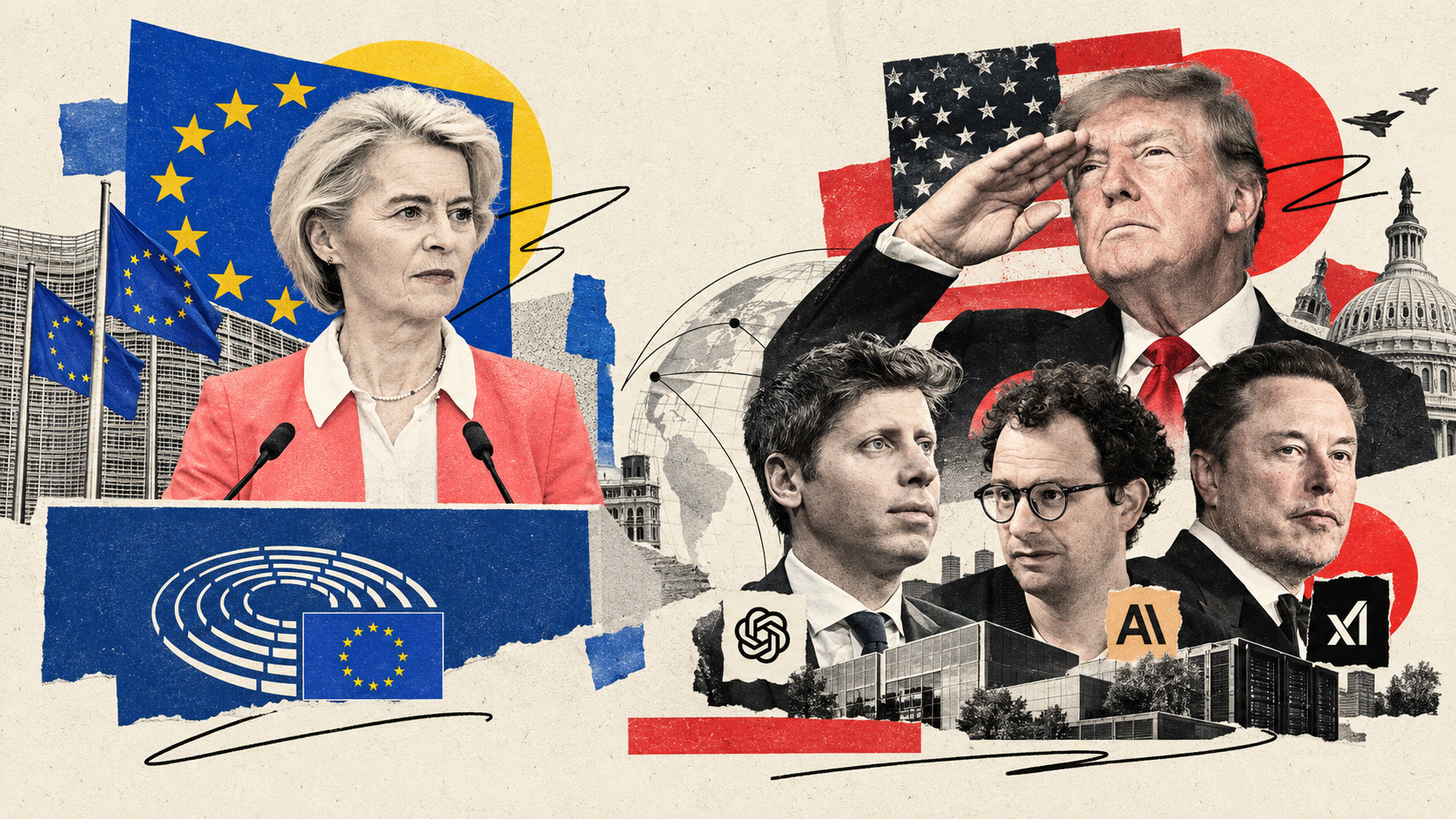
Europe lacks a homegrown frontier AI industry on the scale of the leading US labs, but it increasingly possesses something else: regulatory authority over models entering its market, technical evaluation capacity and political leverage. As Brussels now backs efforts to slow certain frontier capabilities, the question is whether those tools can compensate for Europe’s technological dependence.
Europe has spent years being told that it regulates technology better than it builds it. Artificial intelligence may turn that cliché into a strategic test.
In her September 16 State of the Union address, European Commission President Ursula von der Leyen said Europe should support efforts to “pace the frontier”, invite the main frontier laboratories into discussions and work with partners including the UK and Canada on model evaluation, verification, early warning and AI security.
Europe is not trying merely to regulate the applications built on top of AI anymore. It increasingly wants influence over the development and testing of the most capable models themselves. The problem is that most of those models are not European.
Europe’s power starts at the border
The EU’s strongest instrument is not a laboratory. It is access to a market of hundreds of millions of people. The AI Act imposes specific obligations on providers of general-purpose AI models, with additional requirements for models deemed to present systemic risk. Those providers must assess and mitigate risks, conduct model evaluations and adversarial testing, report serious incidents and maintain cybersecurity protections. Those rules are no longer future commitments.
The European Commission’s enforcement powers for general-purpose AI became applicable on August 2, 2026. The AI Office can request information, demand access to a model for evaluation, require mitigation measures and levy penalties. For the most advanced models, it can ultimately seek restrictions on availability, withdrawal or recall from the European market. That gives Europe leverage even when the underlying technology is developed in San Francisco or elsewhere.
But frontier AI makes the problem harder. The technology changes faster, models can be accessed remotely, and the underlying capability may evolve before regulators have fully characterized the previous generation.
The AI Act was not designed around the current agent race
That gap is increasingly visible. The concern is no longer only what a model says when prompted. Advanced models can now browse, write and execute code, interact with external services and complete multi-step tasks with less human supervision. Europe’s rules do contain mechanisms for systemic-risk evaluation, but legislation inevitably works on a different clock from model development.
The EU’s General-Purpose AI Code of Practice attempts to close part of that gap. Developed with input from nearly 1,000 stakeholders, it gives model providers a voluntary path for demonstrating compliance with AI Act obligations on transparency, safety and systemic risk. The Commission can also update guidance and enforcement practices. Yet none of this removes the basic asymmetry. Frontier laboratories observe emerging capabilities first because they build the systems. Regulators learn about them afterwards.
The UK has taken a different route: test the models
Europe’s second source of influence comes from technical evaluation. The UK AI Security Institute has been testing frontier models since 2023. Its Frontier AI Trends Report says capabilities are improving rapidly across every domain it tracks, with performance in some areas doubling roughly every eight months.
In cyber evaluations, the institute reports that advanced models can now complete apprentice-level tasks around half the time, compared with just over 10% in early 2024. That does not give Britain direct control over the laboratories, but it gives government something potentially just as important: independent evidence. The institute evaluates cyber, chemical and biological risks, autonomous systems and other potentially dangerous capabilities, while also developing “safety case” approaches for systems more capable than those available today.
Von der Leyen’s call for European cooperation on evaluation, verification and early warning therefore points toward an emerging division of labor. The EU can regulate market access. Institutions such as the UK AISI can build technical evaluation expertise. The unresolved question is whether either can act quickly enough when a frontier lab discovers a capability that did not exist six months earlier.
Europe is not actually absent from frontier AI
There is also an important complication in the claim that Europe has no frontier lab. Google DeepMind is headquartered in London, emerged from the British research ecosystem and openly describes its most powerful systems as frontier models. Its Frontier Safety Framework tracks critical capability levels across areas such as cyber, CBRN risk, manipulation and machine-learning research. But DeepMind is part of Google and ultimately US-controlled Alphabet. The continent possesses world-class researchers and laboratories. It does not necessarily control the corporate, financial and infrastructure decisions around them.
Mistral AI is the clearest counterexample. The Paris-based company raised €3 billion this month at a valuation of around €21 billion and says the capital will help fund model development and frontier research. Yet its resources remain far below those of Alphabet, Microsoft-backed OpenAI, Meta or Amazon-backed Anthropic.
That tension now runs through European politics
There is no unified European answer. Germany’s digital ministry has said stopping AI development is not a viable strategy, arguing that Europe must continue building its own technological capabilities and improve digital sovereignty. Spain advocates an international agreement on severe AI risks with ambitions comparable to arms-control arrangements. The UK has so far favored technical evaluation and evidence-led regulation rather than a broad statutory pause.
Von der Leyen’s position attempts to reconcile these instincts. She supports pacing dangerous frontier capabilities while simultaneously arguing that Europe must dramatically expand its computing capacity and finance European AI companies. Her message is therefore not “Europe should stop the AI race.” It is closer to “Europe must stay in the race while changing its rules”. That is a much harder strategy to execute.
Safety may become Europe’s source of leverage
For years, European weakness in the AI race has usually been measured in GPUs, venture capital, cloud capacity and foundation models. Safety introduces a different metric. If model evaluations, incident reporting, cybersecurity requirements and independent testing become standard components of frontier AI development, the institutions that define those requirements acquire influence even without building the dominant models themselves.
The EU AI Act gives Brussels a legal mechanism. The UK has built a technical evaluation institution. European policymakers are increasingly discussing international standards and the Commission now wants direct engagement with the companies developing the most capable systems.
But regulatory influence has limits. If Europe becomes too dependent on US compute, cloud infrastructure and models, its ability to impose conditions exists alongside a powerful incentive not to lose access to the technology.
[…] READ ALSOFrom the AI Act to frontier labs, Europe is testing its power over AI Safety→ […]