

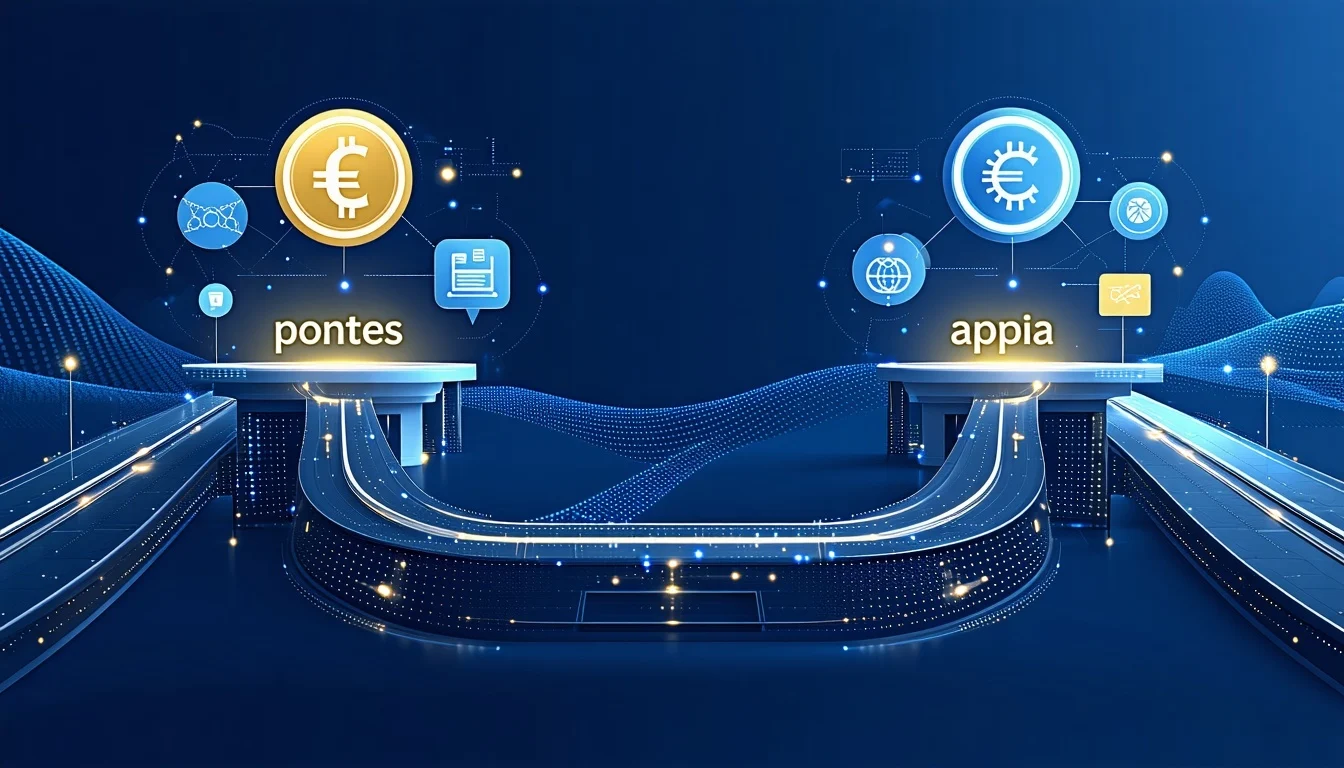
The Eurosystem has launched “Pontes,” a new infrastructure designed to make it easier to settle payments linked to digital financial assets. The idea is straightforward: allow banks to use newer financial technologies, including blockchain-based systems, while still settling transactions in central bank money, the safest form of money available within the financial system.
Operational since September 21, Pontes connects two worlds. On one side are financial platforms built on distributed ledger technology (DLT) which allows transactions and ownership records to be shared and verified digitally. On the other is TARGET, the Eurosystem infrastructure already used to settle large payments and securities transactions between banks and financial institutions.
Pontes is therefore neither a retail digital euro nor a cryptocurrency issued by the European Central Bank. Its role is much more practical. If a bank buys a tokenised bond (essentially a conventional bond represented digitally on a blockchain or similar infrastructure), Pontes allows the cash side of that transaction to be settled using central bank money.
Financial markets are experimenting with tokenisation, which involves representing assets such as bonds, shares or other securities as digital tokens. In theory, this can make parts of the trading and settlement process faster, easier to automate and simpler to track. But for large financial institutions to use tokenised markets at scale, they also need a trusted way to complete the payment itself. That is the gap Pontes is designed to fill.
The project follows around 50 experiments carried out by the Eurosystem in 2024 across nine jurisdictions, representing roughly €1.6 billion in transactions. One of the main conclusions was that access to central bank money would be important if tokenised markets were to expand without introducing unnecessary settlement risk.
Thirteen major financial institutions have already joined the initiative, including Deutsche Bank, Santander, Société Générale, the European Investment Bank, KfW and Caisse des Dépôts. Four specialised digital-market infrastructure providers (Clearstream, Cashlink, Axiology and SWIAT) are also participating. Pontes will initially offer a limited range of services before gradually expanding its functionality and operating hours. Full deployment is planned for 2028.
The European Central Bank also intends to test the infrastructure directly by investing a small portion of its own funds in euro-denominated tokenised public-sector securities. Those purchases will be settled through Pontes, allowing the ECB to gain hands-on experience with the entire process, from acquiring the asset to completing the payment.
Pontes is only the first part of a broader strategy. Through another initiative called Appia, the Eurosystem and Danmarks Nationalbank are working with public and private institutions on a wider architecture that would allow different European tokenised-finance platforms to work together by 2028.
The broader goal is to make emerging digital financial markets compatible with Europe’s existing financial infrastructure. In practical terms, that means using tokenisation to make transactions more automated and potentially faster without giving up the security of settlement in central bank money.
For ordinary people, the immediate impact is very limited. Pontes is a wholesale financial infrastructure for banks and institutions, not a new payment app, currency or consumer service. Over time, however, if tokenised markets become widely used, it could make some financial transactions faster, cheaper and less risky behind the scenes, potentially affecting things like investment products, bond markets, pensions or savings products without consumers ever interacting with Pontes directly.
[…] READ ALSOECB launches Pontes to settle tokenised assets in Central Bank money.→ […]