

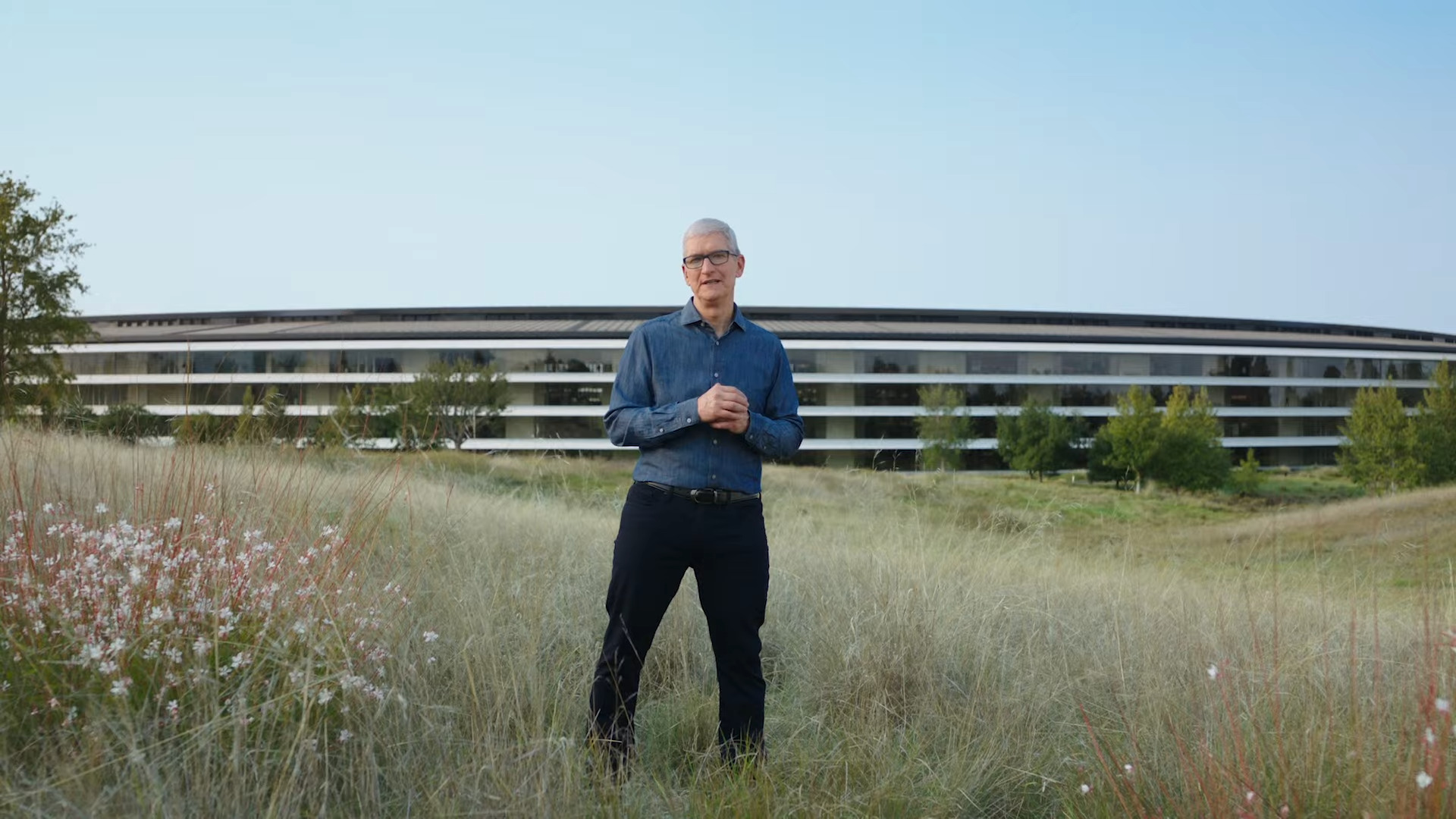
Apple says its greenhouse-gas emissions have fallen by more than 60% since 2015 even as revenue nearly doubled. Cook also pushed renewable electricity and recycled materials across the company’s supply chain, though its former “carbon neutral” claims drew legal and regulatory scrutiny. As Apple Intelligence expands, John Ternus now inherits the challenge of meeting the 2030 climate target without letting AI drive emissions back up.
When Tim Cook stepped down as Apple CEO on September 1 to become executive chairman, most assessments of his 15-year tenure naturally focused on the iPhone, services, Apple’s extraordinary rise in market value and whether he ever produced a new product as transformative as the one he inherited from Steve Jobs. Ant yet, his environmental record is one of the more measurable changes of the Cook era.
Apple says its greenhouse-gas footprint is now more than 60% below 2015 levels. Gross emissions fell from 38.4 million metric tons of CO₂ equivalent that year to 15.3 million in 2025, even as the company says revenue nearly doubled. Emissions declined almost every year after 2021 before remaining roughly flat between 2024 and 2025. This highlights a true absolute decline, rather than a mere reduction in emissions per device or dollar of revenue. »
Cook is nevertheless leaving successor John Ternus with the hardest part of the target. Apple has committed to reducing gross emissions 75% from its 2015 baseline before using carbon removals for the residual footprint. From 38.4 million metric tons, that implies reaching roughly 9.6 million by 2030. Compared with 2025, Apple still has about 5.7 million metric tons to eliminate.
Cook’s biggest climate achievement happened in factories Apple does not own
Apple reached its own 100% renewable-electricity milestone for global corporate operations in 2018. But most of the environmental problem sits outside Apple Park: component manufacturing, assembly, materials and transportation. That is where Apple has distinguished itself most clearly.
The company requires direct suppliers to decarbonize production for Apple by 2030 and has pushed them toward renewable electricity. In 2025, suppliers had procured more than 20GW of renewable capacity through Apple’s Supplier Clean Energy Program and generated more than 38 million megawatt-hours of renewable electricity. Apple separately procured another 1.8GW to support 100% renewable electricity across offices, stores and data centers.
Materials have moved in the same direction. 30% of material in products Apple shipped during 2025 came from recycled or renewable sources. Every Apple-designed battery now uses 100% recycled cobalt and every magnet 100% recycled rare-earth elements.
Even environmental organizations that frequently criticize Big Tech acknowledge the relative lead. Greenpeace East Asia gave Apple the highest score, a B+, in its 2025 ranking of major technology companies, in part because Apple was the only company assessed with a commitment to 100% renewable energy across both its own operations and supply chain by 2030. Greenpeace nevertheless faulted Apple for not publishing total supplier electricity consumption or the overall renewable share across that supply chain.
“Carbon neutral” was the weak point in the message
Apple’s actual emissions reductions have proved easier to defend than some of the marketing language around them.
Beginning in 2023, Apple advertised certain Apple Watch configurations as “carbon neutral.” Its methodology involved sharply reducing the products’ lifecycle emissions and then using carbon credits for the remainder. That approach drew legal challenges. In August 2025, a German court ruled that marketing an Apple Watch as a “CO₂-neutral product” was misleading, pointing in particular to uncertainties over the longevity of a Paraguayan forestry offset project. A separate US class action making claims about Apple’s carbon-neutral marketing was dismissed in February 2026 because the complaint, as pleaded, failed to state a viable claim. Apple has since phased out the label.
European law was moving in that direction regardless. EU Directive 2024/825 prohibits claims that a product has a neutral, reduced or positive greenhouse-gas impact when that claim depends on offsetting emissions outside the product’s value chain. The distinction matters when judging Cook’s record. Criticism of the label does not erase the renewable-power projects, lower-carbon materials or absolute emissions reductions. It shows why those reductions are a more meaningful measure than the word “neutral.”
AI changes the equation
John Ternus now has to finish Apple’s decarbonization plan just as the company’s compute requirements are rising.
So far, Apple has enjoyed a structural advantage over some of its rivals. Many Apple Intelligence features run locally on iPhones, iPads and Macs, while heavier requests can use Private Cloud Compute. Apple says its own data centers are supplied with 100% renewable electricity.
But that architecture is expanding. In June, Apple announced that Private Cloud Compute would move beyond Apple-owned data centers, with Google and Nvidia technologies supporting new Apple Intelligence workloads running on Google Cloud. That gives Apple more AI capacity without immediately reproducing its rivals’ hyperscale infrastructure footprint, but it also makes its AI footprint increasingly dependent on infrastructure and supply chains it does not directly operate.
Google illustrates the pressure. Its electricity demand rose 37% in 2025 amid rapid AI infrastructure growth. It still reduced operational emissions by 2%, but supply-chain emissions jumped 25%. Google itself says its AI buildout is currently moving faster than electricity grids are decarbonizing. Apple has not yet entered the same scale of data-center spending. That is precisely why its current environmental advantage should not be treated as permanent.
Cook demonstrated that a technology company could nearly double revenue while substantially reducing its absolute carbon footprint, and he used Apple’s purchasing power to push hundreds of suppliers toward cleaner electricity. Ternus does not inherit that agenda as an outsider, either: Apple credits him with hardware work involving recycled aluminum, product durability, repairability and lower-carbon design.
The next phase is harder. Reducing emissions while products become more efficient is one challenge. Cutting them by more than a third again from today’s level while demand rises for GPUs, AI servers, semiconductor manufacturing and cloud inference is another.
Cook’s environmental legacy is relatively strong because much of it can be measured. Whether it endures will now depend on something he no longer directly controls: whether an AI-heavy Apple can keep growing without making its carbon footprint grow again.