

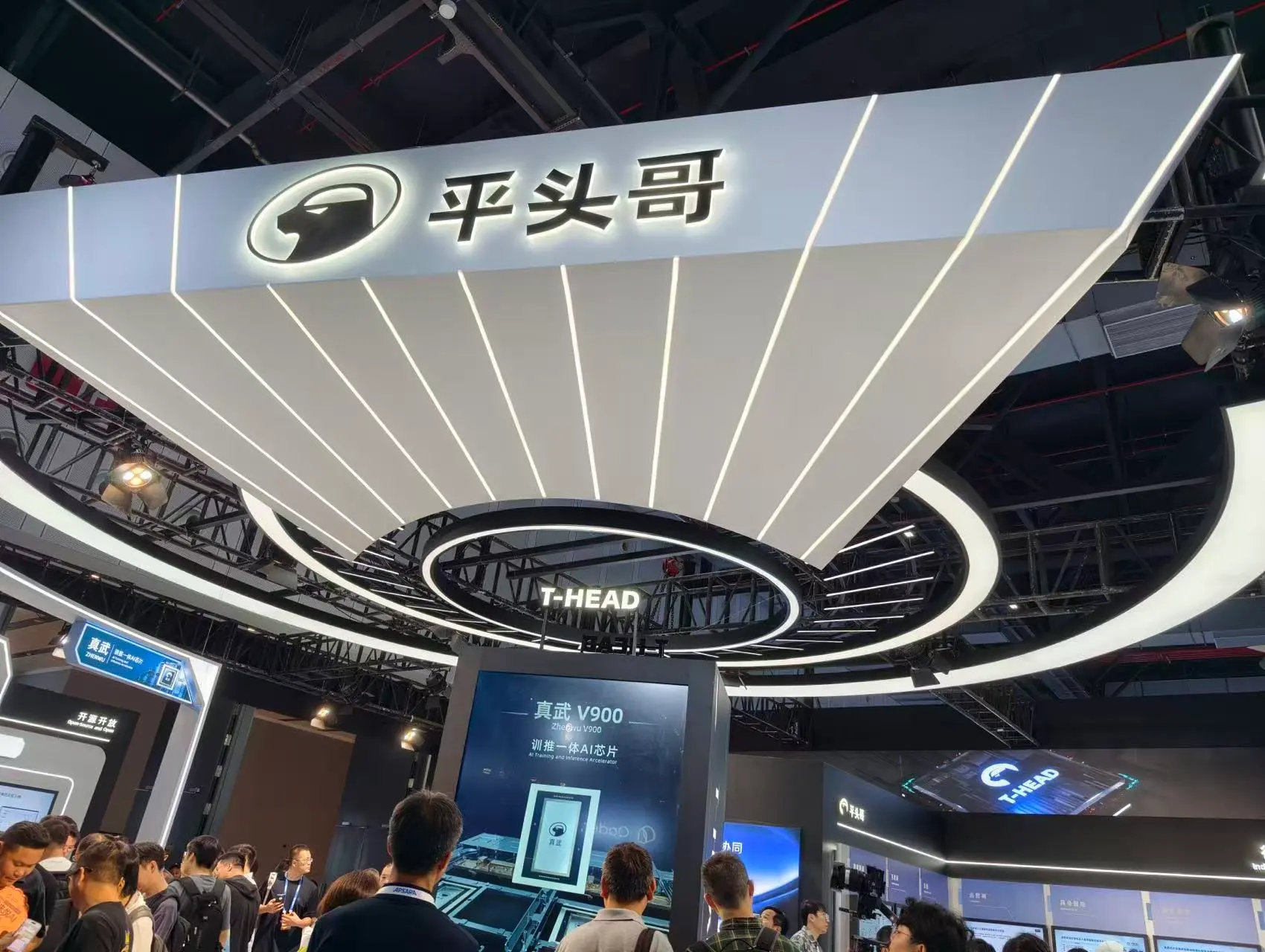
Alibaba has unveiled the Zhenwu V900, which it calls China’s most powerful AI accelerator, alongside plans for models containing up to 10 trillion parameters and more than 20 gigawatts of global data-center capacity by 2032. Together, the announcements outline one of China’s clearest attempts yet to build an AI stack spanning chips, cloud infrastructure and frontier models with less dependence on US technology.
Developed by Alibaba’s T-Head semiconductor unit, the V900 is designed for both model training and inference. CEO Eddie Wu says it delivers three times the performance of the Zhenwu M890 introduced in May and can be interconnected in clusters of as many as 500,000 accelerators. Alibaba says the chip carries 216GB of memory, provides 1.2TB/s of inter-chip bandwidth and supports FP8 and FP4 low-precision computation. Mass production and commercial availability are now scheduled for the first quarter of 2027.
That schedule itself signals acceleration. When Alibaba presented its chip roadmap in May, the V900 had been targeted for the third quarter of 2027. The company has already shipped more than 560,000 processors from the broader Zhenwu family and has begun using its own chips for AI workloads, although previous reporting found Nvidia hardware remained important for its most demanding frontier-model development.
Alibaba has not published independent benchmarks demonstrating that the V900 exceeds every other Chinese accelerator, so its “most powerful” designation remains a company claim. The significance lies in scale. US export restrictions have limited Chinese access to Nvidia’s most advanced processors, increasing the strategic value of domestic alternatives from Alibaba, Huawei and Baidu.
The hardware is being built for substantially larger models. Alibaba says Qwen 4.5 and Qwen 5 could eventually reach 5 trillion to 10 trillion parameters, compared with 2.4 trillion for the current Qwen3.8-Max. Parameter count alone does not determine model quality, but the jump illustrates the computing requirements Alibaba expects from its next generation.
To supply that demand, Alibaba Cloud intends to exceed 20GW of global data-center capacity by 2032. Wu said AI-computing demand is already growing faster than available supply, while the company has committed more than $53 billion to cloud and AI infrastructure over three years.